
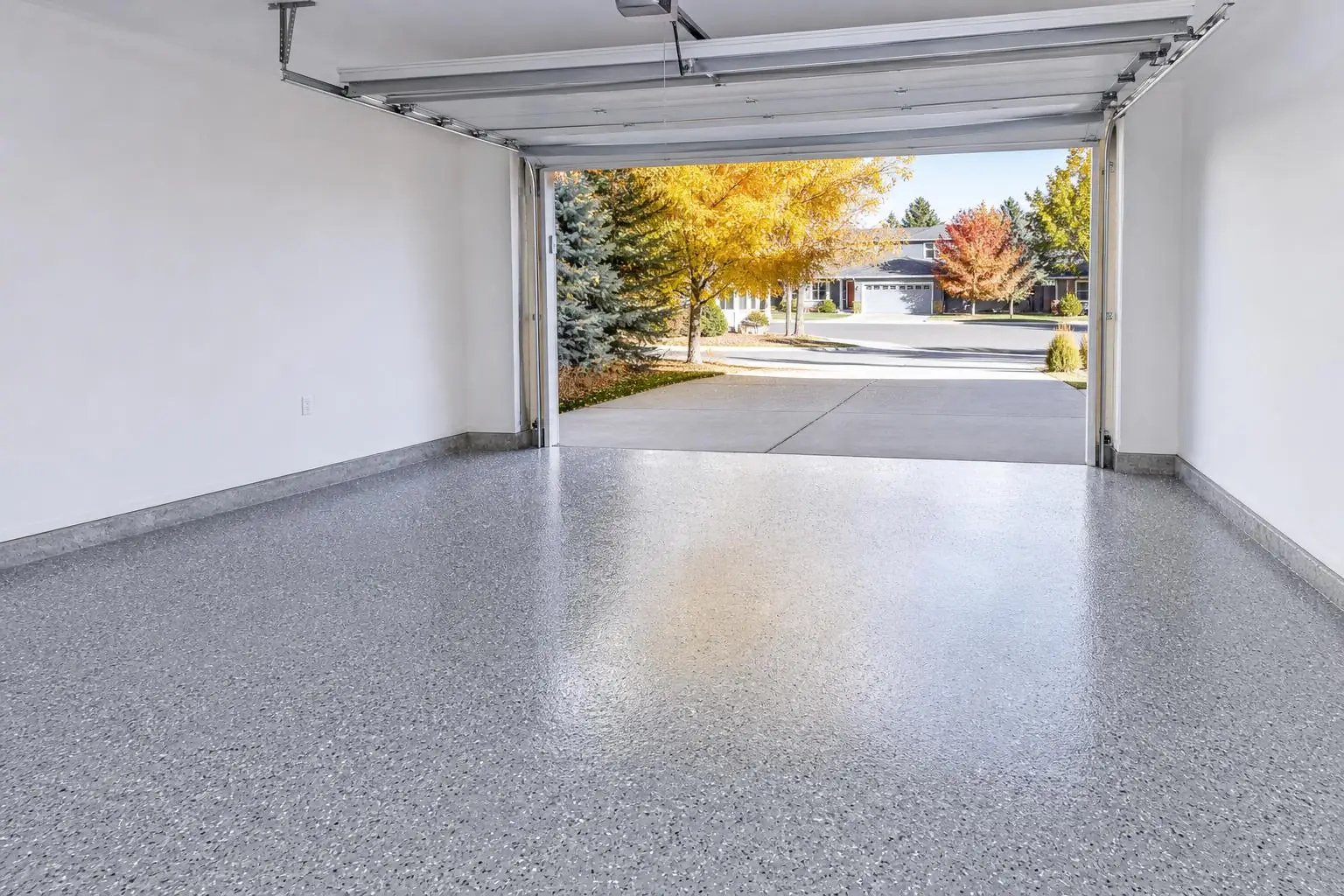
A professionally installed epoxy garage floor in Denver typically costs about $4 to $9 per square foot in 2026, or roughly $1,800 to $5,500 for a two-car garage. Price depends on slab condition, grinding and crack repair, the coating system you choose, and whether you add flakes and a polyaspartic or urethane topcoat.
How Much Does an Epoxy Garage Floor Cost in Denver?
The short answer is that most Denver homeowners pay between $4 and $9 per square foot for a professionally installed epoxy garage floor. That range is a typical Front Range estimate for 2026, not a quote, and it covers diamond grinding, basic crack repair, the base coat, decorative flake and a clear topcoat.
A standard two-car garage is usually 400 to 600 square feet, so a full flake system lands somewhere around $1,800 to $5,500. A three-car garage or an oversized shop can run higher simply because of area, although the price per square foot often drops a little as the job grows.
Typical Front Range price ranges (2026 estimates)
| System | Typical cost per sq ft | Two-car garage (about 450 sq ft) |
|---|---|---|
| Single-color epoxy with clear coat | $4 to $6 | $1,800 to $2,700 |
| Full-broadcast flake with polyaspartic topcoat | $5 to $8 | $2,250 to $3,600 |
| Metallic epoxy | $7 to $12 | $3,150 to $5,400 |
| Heavy slab repair or moisture barrier added | +$1 to $4 | +$450 to $1,800 |
These numbers assume a sound slab. Spalled, heaved or heavily stained concrete changes the math, which is why an on-site look matters more than any online calculator.
What Drives the Price of a Garage Epoxy Floor?
Two garages of the same size can get very different quotes. The difference almost always comes down to the concrete you start with and the system you put on top of it.
Slab condition and surface preparation
Preparation is the single biggest factor in how long a coating lasts, and it is a real share of the cost. Professional crews grind the slab with diamond tooling to open the surface so the coating can bond. Old sealers, paint, oil stains and tire marks all add time. Our floor preparation process starts with this step on every job.
Cracks, spalling and control joints
Denver slabs see freeze-thaw cycles and de-icing salts dripping off cars every winter. Pitted or spalled areas need patching, and cracks need to be filled with a rigid or flexible repair material before any coating goes down. A garage with a few hairline cracks costs little extra. A garage with widespread surface scaling can add several hundred dollars.
Moisture in the slab
If moisture vapor is moving up through the concrete, a standard epoxy can blister or peel. A moisture test tells you whether you need a vapor-mitigating primer, which raises the price but protects the investment.
The coating system
Thin single-coat kits cost the least but wear the fastest. A multi-coat system with a 100%-solids epoxy base, full flake broadcast and a UV-stable polyaspartic topcoat costs more and holds up far better to hot tires, salt and sunlight through an open door.
Epoxy vs. Polyaspartic Topcoats: Does It Change the Cost?
Most quality Denver garage floors today are hybrid systems. The base coat is epoxy, which bonds well and builds thickness, and the topcoat is polyaspartic or urethane. Polyaspartic resists yellowing from UV better than most epoxies, cures faster, and handles abrasion well.
- All-epoxy systems tend to be at the lower end of the price range but can amber over time in sunlight.
- Epoxy base with polyaspartic top usually adds $0.50 to $1.50 per square foot and is the most common choice for Colorado garages.
- Full polyaspartic systems can be installed and returned to light use faster, but they need an experienced crew because the working time is short.
Colorado’s high-altitude sun is stronger than many people expect, so UV stability matters if your garage door stays open on summer afternoons.
Why DIY Kits Cost Less Up Front but More Over Time
Big-box epoxy kits often cost a few hundred dollars for a two-car garage. They are usually water-based or low-solids products applied over an acid-etched slab rather than a ground one. That means a thinner film and a weaker bond.
The most common failure we see is hot-tire pickup, where warm tires soften the coating and pull it off the floor. Peeling around the front of the parking spots is another. Once a DIY coating fails, it has to be ground off before a professional system can go down, which adds cost to the eventual fix.
If you plan to stay in the home for several years, a professional system typically costs less per year of service than a kit that needs to be stripped and redone.
How Denver Weather Affects Your Garage Floor
Denver weather is hard on concrete. The >National Weather Service Denver/Boulder office tracks frequent swings above and below freezing from fall through spring, and snow that melts off cars soaks into bare concrete in every garage.
Many Colorado roads are treated with magnesium chloride and other de-icers during storms, as the >Colorado Department of Transportation explains in its winter driving guidance. Those brines ride into the garage on tires and can attack unprotected concrete surfaces. A sealed, non-porous coating keeps the slurry on top where it can be squeegeed out.
Can you install epoxy in the fall and winter?
Yes, with limits. Most epoxy and polyaspartic products need slab and air temperatures above roughly 50 degrees Fahrenheit to cure properly, according to manufacturers’ data sheets. Crews use heaters and choose fast-curing products when it gets cold. Booking in October or early November often gets your floor done before the worst of the de-icer season.
How to Budget and Compare Epoxy Garage Floor Quotes
When you collect quotes, compare scopes, not just totals. A low number that skips grinding or uses a thin product is not a better deal.
- Ask how the slab will be prepared. Diamond grinding is the professional standard. Acid etching alone is a warning sign.
- Ask about the coating thickness and solids content of each layer.
- Ask whether crack repair and stem walls are included or priced separately.
- Ask about moisture testing, especially for older homes and garages built on grade.
- Get the warranty in writing and understand what it covers, such as peeling versus staining.
- Ask when you can walk and drive on the floor. Light foot traffic often happens in about a day, and vehicles usually wait several days.
You can learn more about our coating systems on the epoxy flooring page.
Why Denver Property Owners Choose True Finishing
True Finishing has prepared, repaired and finished concrete floors across the Colorado Front Range and mountain towns since 2007. Our crews work in Denver and nearby communities, and we handle every step ourselves: moisture testing, grinding, crack and joint repair, and the final finish. That one-stop approach means nobody hands off a slab they did not prepare.
For Denver garages we grind every slab with diamond tooling, repair cracks and control joints, and choose the coating system for the way you actually use the space, from daily parking in snow season to a workshop or home gym. You can see how we approach larger jobs in our commercial case studies.
Ready to talk about your floor? Request a free estimate or call 303-761-1012. We will look at the slab, test it, and give you a written scope with clear pricing.
Frequently Asked Questions
How much does it cost to epoxy a 2-car garage in Denver?
As a typical Front Range estimate for 2026, a two-car garage of about 400 to 600 square feet usually costs $1,800 to $5,500 with professional grinding, crack repair, a flake broadcast and a clear topcoat. Metallic finishes, heavy slab repair or a moisture barrier push the total higher, so an on-site evaluation gives the most accurate number.
Is an epoxy garage floor worth the money?
For most homeowners who plan to stay several years, yes. A professionally installed system resists oil, road salt and hot tires, is easy to clean, and makes the garage brighter and more usable. Cheaper kits often peel within a few years and then need to be ground off, which adds cost to the eventual professional fix.
How long does a professional epoxy garage floor last?
A well-prepared, multi-coat system with a polyaspartic or urethane topcoat commonly lasts 10 to 20 years in a residential garage. Lifespan depends mostly on surface preparation, coating thickness and how the floor is maintained. Topcoats can be scuffed and recoated over time to extend the life of the floor.
How long before I can park on a new epoxy garage floor?
Most floors can take light foot traffic within about 12 to 24 hours. Vehicles usually wait longer, often 3 to 7 days, depending on the products used and the temperature. Cold Denver weather slows curing, so your installer should give you a clear return-to-service date for your specific system.
Does True Finishing offer free estimates for garage floors?
Yes. True Finishing provides free estimates for garage floors in Denver and across the Front Range. We look at the slab, check for moisture and damage, and give you a written scope with pricing. Call 303-761-1012 or request an estimate through our contact page.