
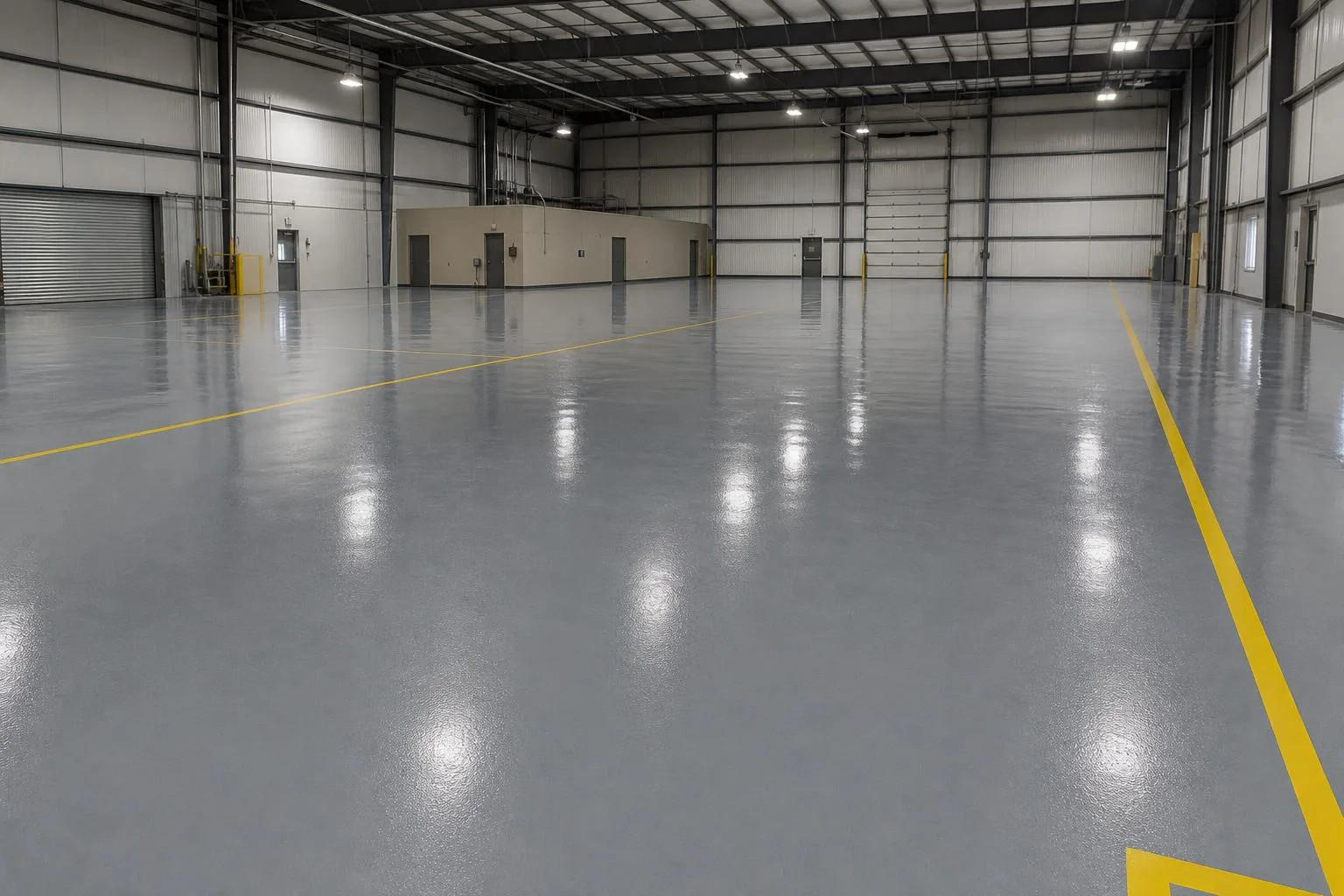
As a typical Front Range estimate for 2026, professionally installed epoxy flooring costs about $4 to $12 per square foot. Simple residential coatings sit near the low end, flake and metallic systems in the middle to upper range, and commercial or industrial systems with heavy prep, moisture mitigation or thick mortar build can cost $8 to $15 or more.
Epoxy Flooring Cost per Square Foot at a Glance
Price per square foot is the easiest way to compare epoxy quotes, but only when the scopes match. The ranges below are typical Front Range estimates for 2026 and include standard diamond grinding and minor crack repair.
| Floor type | Typical system | Typical cost per sq ft |
|---|---|---|
| Residential garage | Epoxy base, flake, polyaspartic top | $5 to $8 |
| Basement | Epoxy with moisture-tolerant primer | $5 to $10 |
| Metallic decorative | Multi-coat metallic epoxy, clear top | $7 to $12 |
| Light commercial | Two-coat epoxy, urethane top | $4 to $8 |
| Heavy industrial | Epoxy mortar or slurry, chemical-resistant top | $8 to $15+ |
Our epoxy flooring page describes each system type in more detail.
Why Small Floors Cost More per Square Foot
A 200-square-foot laundry room often costs more per square foot than a 5,000-square-foot warehouse. Every job carries fixed costs: mobilizing equipment, setting up dust control, mixing minimums and travel. On a small job, those costs are spread over fewer square feet.
Minimum job charges
Many contractors set a minimum project price. If your space is small, ask whether combining areas, such as the garage and a basement utility room, makes the price per square foot more reasonable.
Economies of scale
Large commercial floors benefit from ride-on grinders and larger crews. The per-square-foot price usually drops, although specialized requirements can push it back up.
Surface Preparation: The Biggest Variable
Coating manufacturers specify mechanical preparation for their professional systems, and prep is where quotes differ most. Grinding removes laitance, sealers and contaminants and opens the concrete so the epoxy can bond. Our floor preparation page walks through the process.
- Clean, newer slab: one or two grinding passes.
- Old sealer or paint: extra passes or aggressive tooling.
- Existing failed coating: full removal, often the costliest prep scenario.
- Oil-soaked concrete: degreasing, grinding and sometimes an oil-tolerant primer.
Moisture, Cracks and Repairs
Concrete slabs on grade can transmit moisture vapor that pushes coatings off the surface. A moisture test, such as the in-situ RH probe method in >ASTM F2170, tells you whether a mitigation primer is needed. Moisture mitigation systems typically add about $2 to $5 per square foot as a Front Range estimate.
Crack and joint work
Cracks are chased and filled, and joints are filled or honored. A floor with long runs of cracking will cost more than a clean slab. Spalled areas need patch material that bonds and cures before coating.
System Thickness and Product Quality
Two epoxy floors can look identical on installation day and perform very differently five years later. The main differences are film thickness and resin quality.
Solids content
100%-solids epoxy leaves nearly all the applied material on the floor. Lower-solids products lose volume as water or solvent evaporates, which results in a thinner film.
Topcoat choice
Polyaspartic and aliphatic urethane topcoats resist UV yellowing and abrasion better than most standard epoxies. They add cost but extend the life and appearance of the floor, especially where sunlight hits it.
Industrial build
Epoxy mortar and slurry systems are troweled or broadcast to thicknesses many times greater than a roll coat. They handle heavy impact and thermal shock but cost considerably more.
Hidden Costs to Ask About
- Moving furniture, racking or stored items
- Stem walls, curbs and coves
- Stairs and landings, often priced per step
- Line striping and safety markings
- After-hours or weekend work for occupied businesses
- Disposal of removed coatings
A clear written scope that lists each of these prevents surprises.
How to Get an Accurate Price
Send photos, rough dimensions and a description of how the floor is used, then schedule an on-site visit. A contractor who tests moisture, looks at the existing surface and asks how you use the space will give a far more reliable number than an online calculator.
For background on concrete quality and durability, the >Portland Cement Association publishes useful resources for owners and specifiers.
Questions to ask on the estimate visit
- What moisture reading did you get, and what method did you use?
- How many grinding passes do you expect, and what tooling will you use?
- What is the total dry film thickness of the finished system?
- Which topcoat is included, and is it UV-stable?
- What does the warranty cover, and for how long?
- When can people walk on it, and when can vehicles or equipment return?
Budgeting tips
If budget is tight, spend it on preparation and a quality base coat first. Decorative upgrades such as metallic pigments or custom flake blends can be chosen later on a future project, but a floor with poor prep cannot be fixed without starting over. For commercial owners, scheduling work during planned shutdowns avoids after-hours premiums and keeps the price per square foot closer to the standard range. Homeowners in Aurora often save by booking in late fall or early spring, outside the busiest summer weeks.
Why Aurora Property Owners Choose True Finishing
True Finishing has prepared, repaired and finished concrete floors across the Colorado Front Range and mountain towns since 2007. Our crews work in Aurora and nearby communities, and we handle every step ourselves: moisture testing, grinding, crack and joint repair, and the final finish. That one-stop approach means nobody hands off a slab they did not prepare.
From Aurora homes to warehouses along the I-70 and E-470 corridors, we price every epoxy floor from an on-site evaluation so the number reflects your actual slab, not a guess. You can see how we approach larger jobs in our commercial case studies.
Ready to talk about your floor? Request a free estimate or call 303-761-1012. We will look at the slab, test it, and give you a written scope with clear pricing.
Frequently Asked Questions
How much does epoxy flooring cost per square foot in Colorado?
As a typical Front Range estimate for 2026, professionally installed epoxy flooring usually costs $4 to $12 per square foot. Residential garage flake systems often fall around $5 to $8, metallic floors $7 to $12, and heavy industrial systems $8 to $15 or more. Prep, moisture and repairs drive most of the difference.
Why do epoxy quotes vary so much?
Quotes differ because of surface preparation, coating thickness, product quality, moisture mitigation and how much repair is included. A low price may skip grinding or use a thin product. Compare written scopes line by line, including prep method, number of coats, topcoat type and warranty, rather than comparing totals alone.
Is epoxy cheaper than polished concrete?
It depends on the slab. On a good slab, polished concrete and basic epoxy can be similar in cost per square foot. On a damaged or heavily patched slab, epoxy can be more economical because it hides repairs, while polishing would need more grinding to look uniform. Both are often less costly long-term than replaceable floor coverings.
Does a bigger floor cost less per square foot?
Usually. Fixed costs such as mobilization, setup, dust control and minimum material quantities are spread across more area on a larger floor. Large commercial projects also use bigger equipment. Small rooms often carry a minimum charge, so combining spaces into one project can lower the price per square foot.
How do I get a free epoxy estimate in Aurora?
Call True Finishing at 303-761-1012 or use the contact form on our website. We visit the site, test moisture, review the slab condition and give you a written scope and price for your Aurora garage, basement or commercial floor. Estimates are free.