
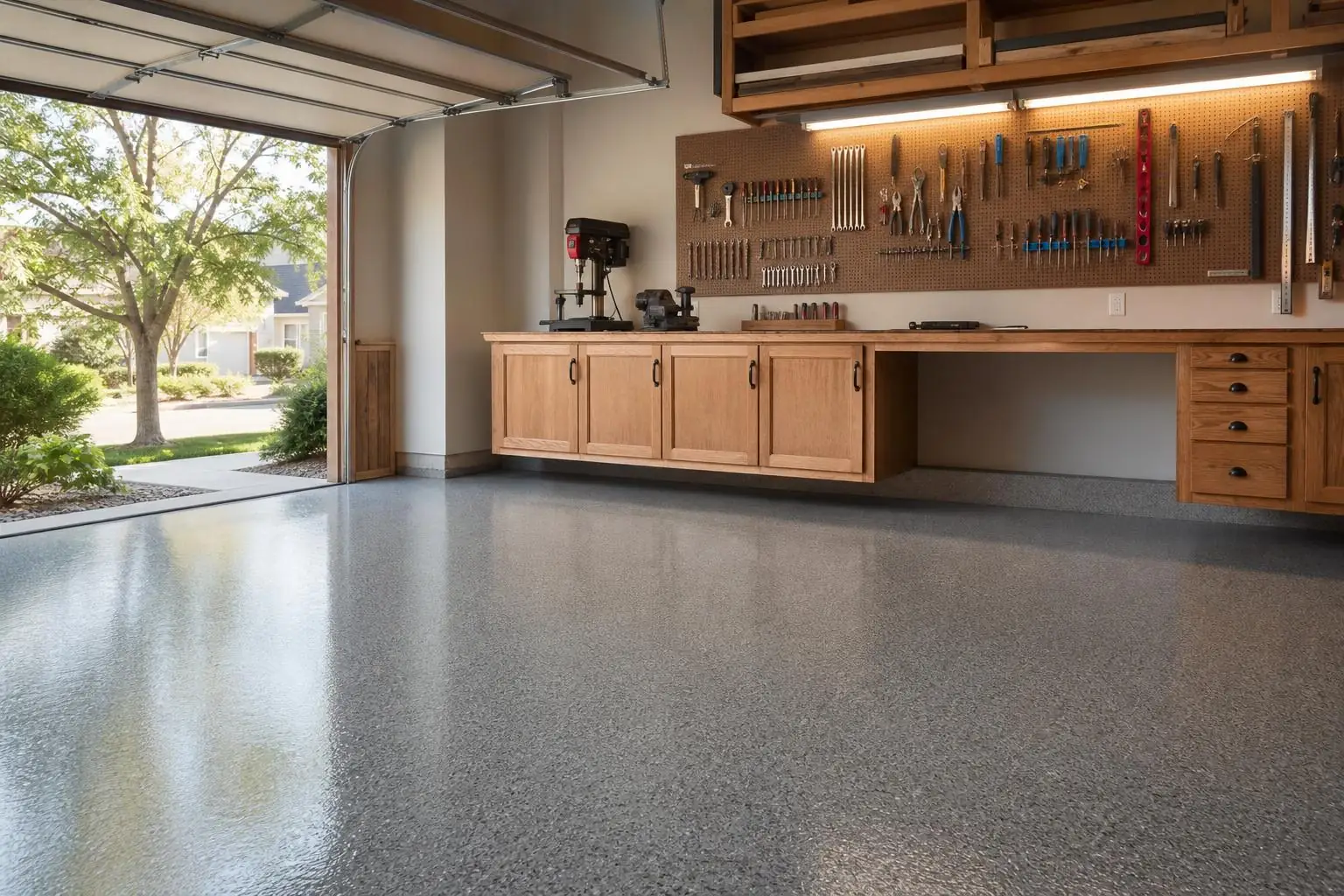
A professionally installed epoxy floor typically lasts 10 to 20 years in a residential garage or basement and about 5 to 15 years in busy commercial spaces before major recoating. Lifespan depends mostly on surface preparation, coating thickness, topcoat type, traffic and maintenance. Thin DIY kits often fail within a few years.
Typical Epoxy Floor Lifespan by Space
There is no single number for how long epoxy lasts, because a garage and a forklift aisle are very different environments. The ranges below reflect common industry experience for professionally installed systems with proper prep and maintenance.
| Space | Typical lifespan before major recoat | Main wear factors |
|---|---|---|
| Residential garage | 10 to 20 years | Hot tires, road salt, dropped tools |
| Basement | 10 to 20+ years | Moisture from below, furniture |
| Retail and office | 7 to 15 years | Foot traffic, grit at entries |
| Warehouse | 5 to 10 years in drive lanes | Forklifts, pallets, abrasion |
| Commercial kitchen | Depends heavily on system | Hot water, grease, thermal shock |
DIY kits are far shorter-lived, often a few years, because they are thinner and applied over etched rather than ground concrete.
The Five Factors That Decide Lifespan
1. Surface preparation
Diamond grinding removes weak paste and contaminants and gives the coating a mechanical profile to grab. Most early peeling is a prep failure. Our floor preparation process is the foundation of every system we install.
2. Moisture in the slab
Vapor pressure from below can push coatings off concrete, causing blisters or delamination. Testing and mitigation where needed prevents this.
3. Coating thickness and solids
Thicker 100%-solids systems take more wear before reaching concrete. A floor with three or four coats lasts much longer than a single thin coat.
4. Topcoat type
Polyaspartic and urethane topcoats resist abrasion and UV better than standard epoxy. They are the layer that takes daily wear and can be renewed.
5. Traffic and maintenance
Grit is the enemy of every floor finish. Floors that are swept and cleaned regularly keep their gloss and protective topcoat far longer.
Signs Your Epoxy Floor Is Wearing Out
- Dull traffic lanes where the topcoat is worn through
- Peeling or lifting at the edges or in parking spots
- Bubbles or blisters, often signaling moisture issues
- Yellowing on all-epoxy floors exposed to sunlight
- Chips that expose bare concrete
- Stains that no longer clean up
Dullness and scratches usually mean a topcoat refresh. Peeling and blisters usually mean a bond or moisture problem that needs more extensive repair.
How Colorado Conditions Affect Epoxy
Northern Colorado combines intense high-altitude sunlight, big temperature swings and long winters with de-icers. The >National Weather Service Denver/Boulder office covers a region where snowy days can be followed by sunny, mild ones, which means floors go through many wet-dry cycles.
- UV exposure through open garage doors yellows standard epoxy. UV-stable topcoats prevent this.
- Snowmelt and salt are hard on bare concrete but easy to clean off a sealed coating.
- Cold installations require temperature control so coatings cure fully and reach their designed properties.
How to Make an Epoxy Floor Last Longer
- Sweep or dust mop regularly to remove abrasive grit.
- Clean with a pH-neutral cleaner, not acids or harsh solvents.
- Put felt pads or mats under heavy items and stands.
- Use plywood under jack stands and when dragging heavy equipment.
- Rinse road salt during winter and squeegee meltwater out.
- Refresh the topcoat when traffic lanes start to dull.
Recoat vs. Replace: Extending the Life of Your Floor
A worn floor with a good bond can usually be recoated. The crew cleans the floor, abrades the existing topcoat to create a profile, repairs any chips, and applies a fresh topcoat. This restores gloss and protection at a fraction of the cost of a new system.
When coatings are peeling or blistering across large areas, recoating will not hold. The old coating must be ground off and the cause addressed, often moisture or contamination, before a new system goes down. The >Portland Cement Association offers background on concrete moisture and surface quality that explains why prep is so important.
Planning ahead
If you are installing a new floor, ask whether the system is designed to be recoated and how often that is recommended for your traffic level. Learn more about our systems on the epoxy flooring page.
What a warranty tells you about lifespan
Warranties are a useful signal but read the fine print. Many cover peeling or delamination caused by installation defects, but not wear, staining, chemical damage or moisture issues that were not tested for. A longer warranty paired with documented grinding and moisture testing usually reflects a contractor who expects the floor to last. Ask what the warranty excludes and what maintenance is required to keep it valid.
Why Fort Collins Property Owners Choose True Finishing
True Finishing has prepared, repaired and finished concrete floors across the Colorado Front Range and mountain towns since 2007. Our crews work in Fort Collins and nearby communities, and we handle every step ourselves: moisture testing, grinding, crack and joint repair, and the final finish. That one-stop approach means nobody hands off a slab they did not prepare.
Around Fort Collins and Northern Colorado, many of the floors we are asked to fix were coated with thin products over unground concrete, so we focus on prep and thickness that give a long service life. You can see how we approach larger jobs in our commercial case studies.
Ready to talk about your floor? Request a free estimate or call 303-761-1012. We will look at the slab, test it, and give you a written scope with clear pricing.
Frequently Asked Questions
How long does epoxy flooring last in a garage?
A professionally installed epoxy garage floor with diamond grinding and a polyaspartic or urethane topcoat commonly lasts 10 to 20 years. Hot tires, road salt and dropped tools are the main wear factors. Thin DIY kits applied over etched concrete often peel within a few years, especially under hot tires.
Why does epoxy peel?
Peeling usually comes from poor surface preparation, coating over sealers or contaminants, moisture vapor from the slab, or thin products that cannot handle hot-tire pickup. Grinding the concrete, testing moisture and using a professional multi-coat system prevents most peeling problems before they start.
Can you recoat an old epoxy floor?
Yes, if the existing coating is still well bonded. The surface is cleaned and abraded, chips are repaired, and a new topcoat is applied. This restores gloss and protection. If the coating is peeling or blistering widely, it should be removed and the cause fixed before a new system is installed.
Does epoxy turn yellow over time?
Many standard epoxies amber or yellow when exposed to UV light, such as sunlight through an open garage door. Using a UV-stable topcoat, like polyaspartic or aliphatic urethane, prevents yellowing. Interior spaces without sunlight see less change, but topcoats are still recommended for wear resistance.
Does True Finishing repair or recoat epoxy floors?
Yes. True Finishing evaluates, repairs and recoats epoxy floors in Fort Collins and across the Front Range, and installs new systems when an old coating has failed. Call 303-761-1012 or request a free estimate through our contact page.