
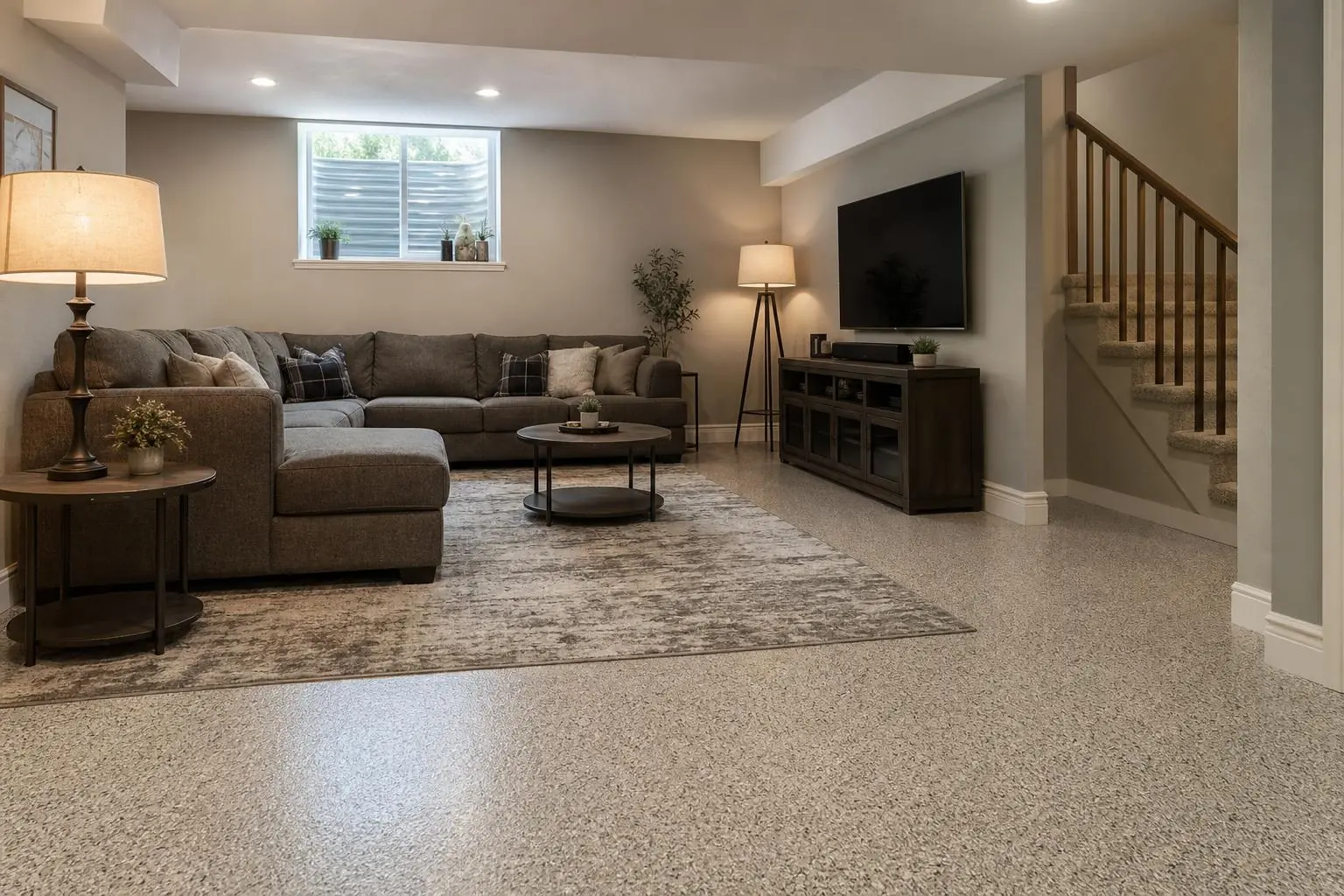
An epoxy basement floor can be durable, easy to clean and attractive, but success depends on moisture. Test the slab first, then use a moisture-tolerant primer if needed, grind and repair the concrete, and choose a system suited to the room. As a typical Front Range estimate for 2026, basement epoxy costs about $5 to $10 per square foot.
Why Basements Are Different From Garages
Basement slabs sit below grade and are surrounded by soil. Even in semi-arid Colorado, moisture can move up through a slab, especially where vapor retarders are missing or damaged, gutters discharge near the foundation, or the water table rises in spring. In a garage, a coating sees hot tires and salt. In a basement, the bigger risk often comes from below.
That is why basement epoxy projects start with testing and prep, not with picking colors.
Step One: Test for Moisture
A taped plastic sheet test gives a rough indication, but quantitative testing is better. The calcium chloride method in >ASTM F1869 measures moisture emission at the surface, and in-situ RH probes measure moisture inside the slab.
Reading the results
- Low readings: a standard epoxy primer and system usually work well.
- Moderate to high readings: use a moisture-tolerant or vapor-mitigating epoxy primer rated for the measured level.
- Liquid water, efflorescence or seepage: fix drainage or waterproofing first.
Our concrete moisture mitigation service installs systems designed for high-moisture slabs.
Radon and Basement Floors
Colorado has elevated radon potential in many areas. The >Colorado Department of Public Health and Environment recommends testing homes for radon. A coating is not a substitute for a radon mitigation system, but sealing cracks and the slab surface is often part of an overall approach. If your home has a radon fan and piping, the coating crew should work around the suction point and keep the system operating as designed.
Preparing the Basement Slab
- Remove carpet, pad, tack strips and any glue residue.
- Diamond grind to remove paint, sealers and weak surface paste.
- Fill cracks and repair spalls. Honor control joints.
- Check flatness if furniture or flooring transitions matter.
- Vacuum thoroughly and apply the selected primer.
Dust control matters in a lived-in home. HEPA extraction keeps the rest of the house clean while the crew works.
Design Options for Basement Epoxy
| System | Look | Best for |
|---|---|---|
| Flake broadcast | Speckled, textured, hides dust | Family rooms, gyms, playrooms, laundry |
| Metallic epoxy | Marbled, glossy, high-end | Bars, theaters, entertainment spaces |
| Solid color | Clean, uniform | Storage, utility and workshop areas |
| Quartz broadcast | Textured, very durable | Bathrooms and wet areas |
Area rugs can soften living spaces. Choose rugs with breathable backing so moisture does not get trapped against the coating.
Basement Epoxy Cost (Front Range 2026)
As a typical Front Range estimate for 2026, basement epoxy floors range from about $5 to $10 per square foot. Simple flake systems over a dry slab fall at the low end. Moisture mitigation primers add roughly $2 to $5 per square foot. Metallic systems and heavy prep, such as removing old glue or tile mortar, push costs higher.
- 500 square foot family room, flake system: about $2,500 to $4,500
- Add moisture mitigation: about $1,000 to $2,500 more
- Metallic bar area, 300 square feet: about $2,100 to $3,600
Living With an Epoxy Basement Floor
Epoxy floors are cool to the touch, which is welcome in summer. Many homeowners add rugs and use the floor as-is for gyms, craft rooms and play areas. Cleaning is simple with a microfiber mop and pH-neutral cleaner. If a pipe leaks or a window well floods, a coated floor can be dried and cleaned far more easily than carpet. Learn more on our epoxy flooring page.
Timeline for a typical basement project
Most residential basement floors take two to four days from start to finish. Day one is usually removal of old flooring, grinding and repairs. Day two covers primer and base coats, including any moisture mitigation layer. The final day is the flake or metallic layer and topcoat. Light foot traffic is commonly allowed about a day after the topcoat, and furniture can return a few days later depending on the products and temperature.
Coordinating with other basement work
If you are finishing the basement, plan the floor after drywall and painting but before baseboards and trim. That way the coating can run tight to the walls, the baseboard covers the edge, and no other trades are dragging ladders or tools across a new floor. Plumbing and electrical rough-ins should be complete, and any floor penetrations should be sealed before coating. Let the crew know about floor drains, sump pits and radon suction points ahead of time so they can plan edges and transitions around them cleanly.
Why Littleton Property Owners Choose True Finishing
True Finishing has prepared, repaired and finished concrete floors across the Colorado Front Range and mountain towns since 2007. Our crews work in Littleton and nearby communities, and we handle every step ourselves: moisture testing, grinding, crack and joint repair, and the final finish. That one-stop approach means nobody hands off a slab they did not prepare.
Littleton basements range from older slabs with years of paint and carpet glue to newer homes with radon systems and finished living space, and we tailor prep and moisture control to each one. You can see how we approach larger jobs in our commercial case studies.
Ready to talk about your floor? Request a free estimate or call 303-761-1012. We will look at the slab, test it, and give you a written scope with clear pricing.
Frequently Asked Questions
Is epoxy good for basement floors?
Yes, when moisture is tested and controlled. Epoxy creates a durable, easy-to-clean surface that handles spills and minor water events better than carpet. Slabs with high moisture need a vapor-mitigating primer, and active leaks or seepage must be fixed first. With proper prep, basement epoxy can last many years.
How much does an epoxy basement floor cost?
As a typical Front Range estimate for 2026, basement epoxy floors cost about $5 to $10 per square foot. Flake systems over a dry slab are at the low end, while moisture mitigation, removal of old glue or tile, and metallic designs increase the price. A site visit and moisture test provide an accurate quote.
Will epoxy stop water in my basement?
No. Epoxy coatings are not a substitute for drainage or waterproofing. They resist spills and surface water, and moisture mitigation primers handle vapor from the slab, but liquid water from cracks, high water tables or foundation leaks must be fixed with grading, gutters, drains or waterproofing first.
Can I epoxy over a painted basement floor?
Paint should be removed by grinding before applying epoxy. Coatings bonded to old paint can only be as strong as the paint bond to the concrete, which is often weak. Grinding removes the paint and opens the surface so the new system bonds directly to sound concrete.
Does True Finishing coat basement floors in Littleton?
Yes. True Finishing tests, prepares and coats basement floors in Littleton and across the Front Range, including moisture mitigation when needed. Call 303-761-1012 or request a free estimate through our contact page to get started.