
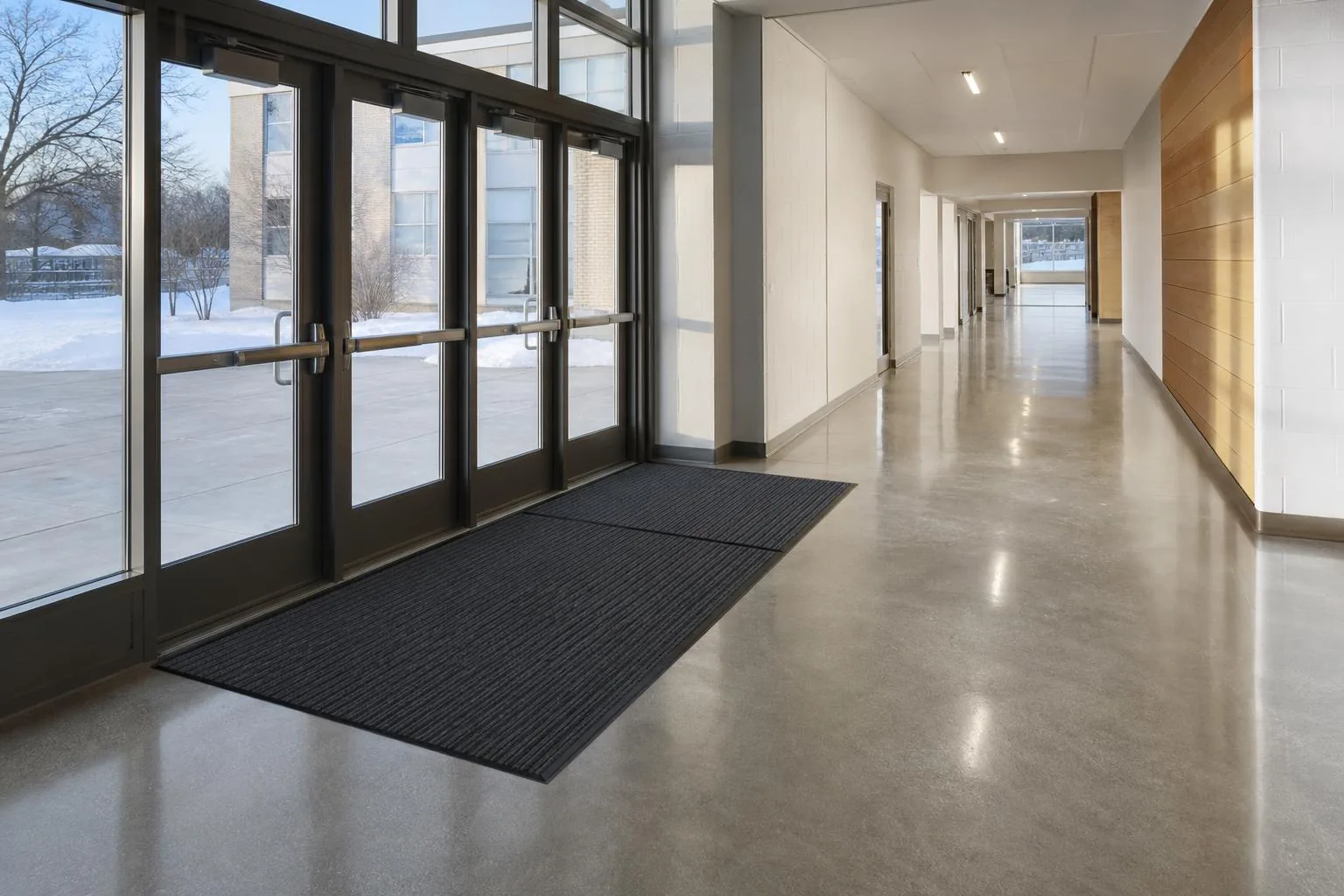
Clean, dry polished concrete is generally not slippery, because polishing refines the surface without coating it in a slick film. Shine is about light reflection, not friction. Polished floors become slippery when wet, oily or dusty, so entry mats, prompt cleanup, proper cleaners and well-maintained guards are what keep them safe.
Shine Is Not the Same as Slipperiness
People often assume a shiny floor must be slippery. With polished concrete, the shine comes from refining the surface with progressively finer diamonds until it reflects light. It does not come from wax or a thick coating sitting on top. In many cases, a well-maintained polished floor offers better traction when dry than waxed vinyl tile, which relies on layers of finish that can be slick.
What matters for slip resistance is friction between the shoe and the floor, and that friction changes dramatically with contaminants: water, snowmelt, oil, dust and cleaning residue.
What Makes Polished Concrete Slippery
- Water and snowmelt tracked in at entries
- Grease and oil in kitchens, garages and loading areas
- Fine dust from construction or poor entry matting
- Residue from wrong cleaners, especially soaps that leave film
- Topical coatings added over polished concrete that are not designed for traction
Most slip incidents happen in transition zones, where people step from outdoors onto a hard floor with wet shoes.
What OSHA and the ADA Say About Floors
Under >OSHA 29 CFR 1910.22, employers must keep walking-working surfaces clean, orderly and sanitary, and free of hazards like spills. Where wet processes are used, drainage and dry standing places must be maintained where practical. The rule focuses on housekeeping rather than a single friction number.
The ADA accessibility standards, published through the >U.S. Access Board, require floor surfaces on accessible routes to be firm, stable and slip resistant. Polished concrete is firm and stable, and its slip resistance is managed through finish selection and maintenance.
How Slip Resistance Is Measured
Floor traction is commonly tested with a tribometer that measures the dynamic coefficient of friction (DCOF). ANSI A326.3 is a widely referenced test method for hard surface flooring, and many specifiers use a wet DCOF value of 0.42 as a benchmark for level interior floors expected to be walked on when wet. Owners with high liability exposure sometimes test floors after installation and periodically after.
| Factor | Effect on traction |
|---|---|
| Higher gloss | Little direct effect when clean and dry |
| Water on surface | Reduces traction on any smooth floor |
| Correct neutral cleaner | Maintains traction |
| Soap or wax residue | Reduces traction |
| Slip-resistant guard | Can improve wet traction |
Making Polished Floors Safer
At entries
- Install walk-off mats long enough for several steps, both outside and inside the door.
- Add extra mats during snow events and keep them clean.
- Use wet floor signs and mop entries frequently on storm days.
In daily cleaning
- Use a pH-neutral cleaner designed for polished concrete.
- Rinse or use an auto-scrubber that picks up dirty water.
- Avoid soaps, oils and waxes that leave film.
In finish selection
- Choose satin or semi-gloss for entries and ramps.
- Ask about slip-resistant guards for wet zones.
- Consider textured coatings in commercial kitchens and wash bays instead of polished concrete.
Polished Concrete in Homes
In homes, polished concrete is popular in basements, main floors and modern kitchens. Slip risk is managed the same way: rugs at sinks and doors, quick cleanup of spills and the right cleaner. Socks on any smooth floor are slicker than bare feet or shoes, so families with young children or older adults often choose a satin finish and add runners in hallways.
Learn more about finish options on our concrete polishing page.
Winter in Westminster
Snow and de-icer tracked in from parking lots are the biggest winter risk for polished floors along the US-36 corridor. Good matting, frequent mopping and promptly removing salt residue keep floors safe and protect the finish from etching. In spring, a deep clean and fresh guard restore traction and appearance after a long season of snowmelt.
A simple safety checklist for facility managers
- Map the entries and wet zones where slips are most likely.
- Size walk-off matting so most people take several steps on mats before reaching the polished floor.
- Train custodial staff on the correct cleaner and dilution.
- Keep a storm-day plan with extra mats, signs and mopping frequency.
- Consider periodic DCOF testing and keep records with your safety files.
These steps cost little and address the real drivers of slips on any hard floor. They also show that the organization took reasonable steps to keep floors safe, which matters if an incident ever occurs. Reviewing the plan each fall, before the first major snowstorm, keeps everyone ready for the season when polished floors are most at risk.
Why Westminster Property Owners Choose True Finishing
True Finishing has prepared, repaired and finished concrete floors across the Colorado Front Range and mountain towns since 2007. Our crews work in Westminster and nearby communities, and we handle every step ourselves: moisture testing, grinding, crack and joint repair, and the final finish. That one-stop approach means nobody hands off a slab they did not prepare.
We polish floors in Westminster schools, offices, retail and homes, and we help owners plan gloss levels, mats and maintenance routines that keep floors safe through winter. You can see how we approach larger jobs in our commercial case studies.
Ready to talk about your floor? Request a free estimate or call 303-761-1012. We will look at the slab, test it, and give you a written scope with clear pricing.
Frequently Asked Questions
Is polished concrete slippery when wet?
Like most smooth hard floors, polished concrete is more slippery when wet than when dry. Water, snowmelt and oil reduce traction. Entry mats, prompt cleanup, proper neutral cleaners and slip-resistant guards in wet zones keep polished floors safe. In kitchens and wash bays, textured coatings may be a better fit.
Is polished concrete more slippery than tile?
When clean and dry, polished concrete is generally comparable to or better than many smooth tiles and waxed vinyl, because there is no slick wax layer. Wet conditions reduce traction on all smooth floors. Slip resistance depends more on contaminants and maintenance than on the material itself.
Does a higher gloss make concrete more slippery?
Not directly. Gloss is about how the surface reflects light, while slip resistance depends on friction. A high-gloss polished floor that is clean and dry can have similar traction to a satin one. Choosing satin for entries can still help because it hides wet spots less and shows dirt less.
How do you make polished concrete less slippery?
Keep it clean and dry, use walk-off mats at entries, clean with a pH-neutral polished concrete cleaner, and avoid wax or soap residue. For wet areas, ask about slip-resistant guards or texture treatments. Periodic friction testing can confirm safety in high-liability commercial spaces.
Can True Finishing improve slip resistance on my floor?
Yes. True Finishing evaluates polished and coated floors in Westminster and across the Front Range, recommends finish and maintenance changes, and applies slip-resistant guards or textures where needed. Call 303-761-1012 or request a free estimate.