
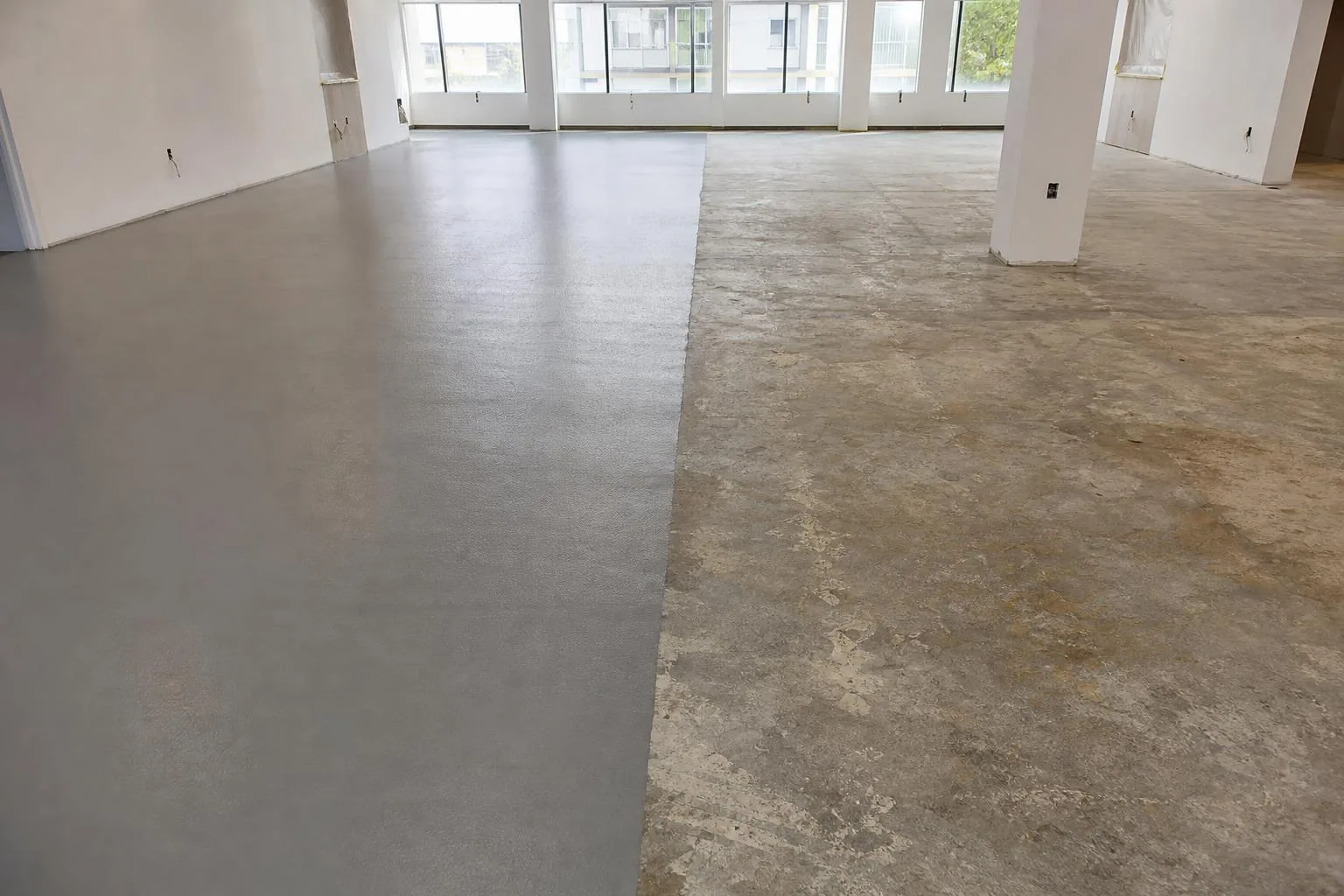
A concrete overlay is a thin polymer-modified cement layer bonded to an existing slab to restore a worn, scaled or stained surface. It typically costs far less than tearing out and repouring, with less mess and downtime. Overlays work when the slab underneath is structurally sound. Replacement is better when the slab is heaving, crumbling or failing.
What Is a Concrete Overlay?
A concrete overlay is a cement-based material modified with polymers so it can be applied thinly and bond tightly to existing concrete. Overlays range from skim coats a fraction of an inch thick to self-leveling and trowel-applied toppings of a half inch or more. They can be left as a finished surface, stained, sealed, polished or used as a base for coatings.
Our concrete overlay service covers interior floors, garages and commercial spaces.
When an Overlay Makes Sense
- Surface scaling, pitting or spalling from salt and freeze-thaw
- Old stains, patches and mismatched repairs
- Rough or uneven surfaces after removing tile or carpet glue
- Worn traffic lanes in older commercial buildings
- A desire for a new decorative look without demolition
The key requirement is a sound base. If the slab is solid and not moving, an overlay can give it a new surface.
When Replacement Is the Better Choice
- Slabs that are actively heaving from expansive soils
- Large sections that are sunken, broken or rocking
- Deteriorated concrete that crumbles deeply when tapped or probed
- Slabs that need new plumbing, radiant heat or a vapor retarder installed beneath
- Structural damage identified by an engineer
The >American Concrete Institute publishes repair guidance that engineers use when deciding between surface repair and replacement.
Cost Comparison (Front Range 2026)
| Option | Typical cost per sq ft | Downtime |
|---|---|---|
| Skim coat overlay | $4 to $7 | 1 to 3 days |
| Self-leveling or trowel overlay | $6 to $12 | 2 to 4 days |
| Overlay plus coating or polish | $9 to $16 | 3 to 6 days |
| Interior slab demo and repour | Often $12 to $25+ | 1 to 3+ weeks |
These are typical Front Range estimates. Replacement costs vary widely with access, demolition, haul-off, plumbing and finishing. Interior replacement also creates far more disruption and dust.
Lifespan and Performance
A properly bonded overlay on a sound slab can last many years, especially when topped with a sealer or coating that protects it from abrasion and stains. The overlay is only as good as its bond, so preparation is critical: the existing surface is shot blasted or ground to the profile the manufacturer requires, cracks are repaired, and joints are honored so they do not reflect through.
Typical overlay process
- Evaluate the slab for soundness, cracks and moisture.
- Mechanically prepare to the specified profile.
- Repair cracks and treat joints.
- Prime and apply the overlay in one or more lifts.
- Finish, seal, stain, polish or coat.
Environmental and Practical Benefits
Overlays reuse the existing slab, which avoids demolition, hauling and new concrete. The >Portland Cement Association discusses the environmental footprint of cement and concrete production, and reusing sound slabs is one practical way to reduce new material use. Practically, overlays keep homes and businesses usable with far less noise, dust and time than replacement.
Arvada considerations
Older Arvada neighborhoods often have garage and basement slabs that have seen decades of salt, oil and patching. If the slab is stable, an overlay followed by a flake coating can make a garage look new in a few days. If soil movement is active, we will recommend addressing drainage or structural issues first.
Decorative options with overlays
Because the overlay creates a fresh cement surface, it opens up design choices that a worn slab cannot offer. Overlays can be stained with translucent color, dyed and polished, scored into tile or stone patterns, or used as a smooth base for epoxy and flake systems. In retail and restaurant spaces, a stained and sealed overlay can deliver an upscale concrete look at a fraction of the cost of new stone or tile.
Questions to ask before choosing
- Is the existing slab sound, and how was that confirmed?
- What surface profile and primer does the overlay manufacturer require?
- How will cracks and joints be handled?
- What finish will protect the overlay, and how is it maintained?
- What is the total downtime from prep to full use?
- What warranty covers the overlay bond, and what voids it?
- Can the overlay be refreshed or recoated in the future without removal?
Clear answers to these questions usually make the overlay-versus-replacement decision obvious. If a contractor cannot explain how they confirmed the slab is sound, or skips prep details, get another opinion before committing. A small investment in evaluation, such as a few test areas or a pull-off bond test on commercial work, protects a much larger investment in the finished floor and avoids paying twice.
Why Arvada Property Owners Choose True Finishing
True Finishing has prepared, repaired and finished concrete floors across the Colorado Front Range and mountain towns since 2007. Our crews work in Arvada and nearby communities, and we handle every step ourselves: moisture testing, grinding, crack and joint repair, and the final finish. That one-stop approach means nobody hands off a slab they did not prepare.
Arvada has many older homes and commercial buildings with worn slabs that are structurally fine, and an overlay is often the most sensible way to give them a new surface. You can see how we approach larger jobs in our commercial case studies.
Ready to talk about your floor? Request a free estimate or call 303-761-1012. We will look at the slab, test it, and give you a written scope with clear pricing.
Frequently Asked Questions
How much does a concrete overlay cost?
As a typical Front Range estimate for 2026, interior concrete overlays cost about $4 to $12 per square foot depending on thickness and finish, and $9 to $16 with a coating or polish on top. Prep, repairs and access affect price. That is usually far less than demolition and repour.
How long does a concrete overlay last?
A well-bonded overlay on a sound slab can last many years, particularly when protected by a sealer or coating. Lifespan depends on preparation, product quality, thickness and traffic. Overlays on slabs that are still moving or poorly prepared can crack or delaminate early.
Can you overlay cracked concrete?
Yes, if the cracks are stable. Cracks are repaired before overlaying, and moving joints are honored so they do not reflect through. Slabs with active heaving or structural cracking should be evaluated and fixed first, because an overlay will not stop movement in the slab below.
Is it cheaper to overlay or replace concrete?
Overlaying is usually much cheaper than replacing interior concrete because it avoids demolition, hauling, forming and new pours. It also causes less disruption. Replacement makes sense when the slab is structurally failing, heaving or needs new systems installed beneath it.
Does True Finishing install concrete overlays in Arvada?
Yes. True Finishing evaluates slabs and installs concrete overlays, followed by coatings or polish when needed, in Arvada and across the Front Range. We will tell you honestly if replacement is the better option. Call 303-761-1012 for a free estimate.