
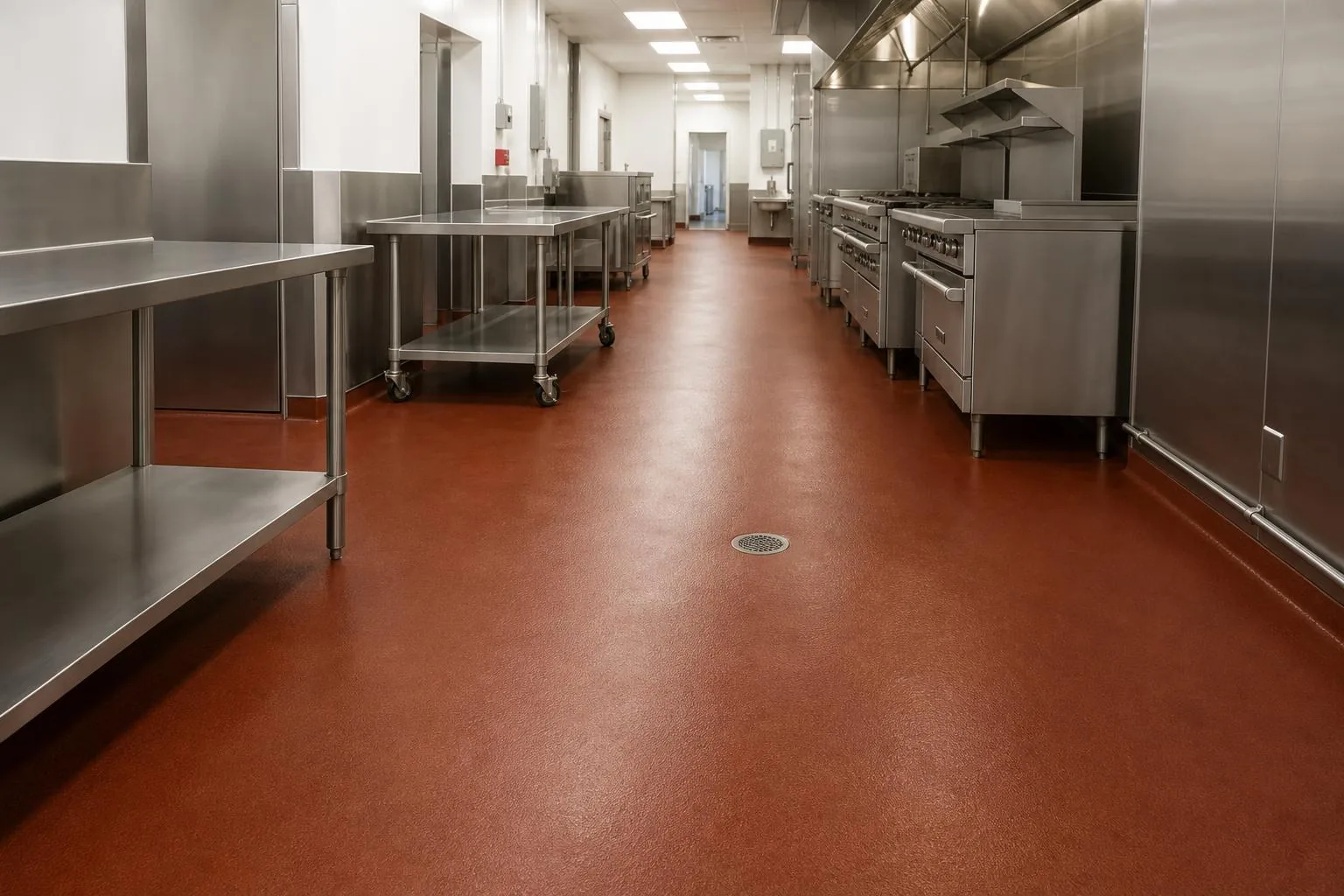
Commercial kitchen floors must be smooth, durable, nonabsorbent and easily cleanable under the FDA Food Code adopted in Colorado, with coved bases where floors meet walls in many cases. Urethane cement and heavy-duty epoxy systems with textured topcoats are popular because they resist hot water, grease and thermal shock while providing slip resistance.
What Colorado Kitchens Must Meet
Colorado’s retail food establishment rules are based on the >FDA Food Code. The Food Code requires floors in food preparation, storage and warewashing areas to be designed, constructed and installed so they are smooth, durable and easily cleanable, and in areas subject to moisture, nonabsorbent. It also addresses floor-wall junctions, which in many areas must be coved and sealed so debris and moisture cannot collect.
Local health departments review plans for new and remodeled kitchens and inspect finishes. Confirm current requirements with your local agency before choosing a system.
Key floor requirements in plain terms
- Smooth, durable and easy to clean
- Nonabsorbent where exposed to water or grease
- Coved and sealed floor-to-wall junctions in many areas
- Properly sloped to floor drains where water is used for cleaning
- No open seams, cracks or grout lines that trap soil
Why Tile and Grout Struggle in Kitchens
Quarry tile has a long history in kitchens, but grout lines are porous and wear over time. Cracked tiles and missing grout create places for water, grease and bacteria to collect and make floors harder to sanitize. Many owners now choose seamless resin systems that eliminate joints except where needed for building movement.
Best Seamless Systems for Commercial Kitchens
| System | Strengths | Considerations |
|---|---|---|
| Urethane cement (urethane concrete) | Excellent thermal shock and hot water resistance, moisture tolerant | Matte look, limited colors |
| Epoxy mortar with textured topcoat | Very durable, chemical resistant | Less tolerant of extreme heat cycling |
| Broadcast quartz epoxy | Decorative, slip resistant | Best for moderate heat areas |
| MMA (methyl methacrylate) | Very fast cure, cold-weather install | Strong odor during install |
Urethane cement is widely used in commercial kitchens and food plants because it handles hot water washdowns and temperature swings near ovens, fryers and dish areas. See our epoxy and resin flooring page for system options.
Slip Resistance and Worker Safety
Kitchens are among the most slip-prone workplaces because of water, grease and food debris. >OSHA’s walking-working surfaces standards require floors to be kept clean and, where wet processes are used, to maintain drainage or provide dry standing places such as mats or platforms.
How resin floors improve traction
- Aggregate broadcast into the topcoat creates texture that grips wet shoes.
- Texture can vary by zone: heavier at the fry line, lighter in dry storage.
- Correct slope to drains reduces standing water.
There is a trade-off. More texture improves grip but takes more effort to clean, so the profile should match each area.
Cove Bases, Drains and Details
The details are where kitchen floors succeed or fail:
- Integral cove base: resin is troweled up the wall several inches to create a seamless curved junction.
- Drain terminations: the floor system is carefully finished into drain bodies and trench drains.
- Equipment curbs: walk-in cooler thresholds and equipment bases are coated as part of the system.
- Joints: movement joints are honored and sealed with flexible sealant.
Planning Installation Around Service
Restaurants cannot close for weeks. Common approaches include installing over a long weekend, phasing the kitchen into sections, and using fast-cure systems. Urethane cement and MMA systems can return to service quickly when products and temperatures allow.
What happens before install
- Remove failed tile and mortar, then grind or shot blast the slab.
- Test moisture and treat contamination from years of grease.
- Repair slab damage and adjust slope where possible.
- Coordinate with equipment vendors for moving and reconnection.
Our floor preparation process handles tear-out and grease-contaminated concrete.
Typical Costs
As a typical Front Range estimate for 2026, seamless commercial kitchen floors commonly range from about $10 to $20 per square foot, including tile removal, prep, cove base and a textured resin system. Small kitchens with many details cost more per square foot. Urethane cement and MMA systems usually cost more than standard epoxy, but their durability in harsh kitchen conditions often makes them the better long-term value.
Englewood and south metro kitchens
From restaurants along South Broadway to school and senior living kitchens, we see many floors with failing quarry tile and grout. Replacing them with a seamless system typically reduces cleaning time and improves inspection results.
Daily cleaning that protects the floor
Seamless floors make sanitation easier, but routine still matters. Scrape and sweep food debris, use the degreaser and dilution recommended for your system, scrub with a deck brush or auto-scrubber, and squeegee water to drains instead of leaving it to dry. Avoid scraping with metal blades that can gouge topcoats. Inspect cove bases and drains monthly.
Why Englewood Property Owners Choose True Finishing
True Finishing has prepared, repaired and finished concrete floors across the Colorado Front Range and mountain towns since 2007. Our crews work in Englewood and nearby communities, and we handle every step ourselves: moisture testing, grinding, crack and joint repair, and the final finish. That one-stop approach means nobody hands off a slab they did not prepare.
We install seamless kitchen floors for restaurants, breweries, schools and food producers in Englewood, Denver and across the Front Range, and we plan work around service schedules and inspections. You can see how we approach larger jobs in our commercial case studies.
Ready to talk about your floor? Request a free estimate or call 303-761-1012. We will look at the slab, test it, and give you a written scope with clear pricing.
Frequently Asked Questions
What flooring is required in a commercial kitchen?
Under the FDA Food Code adopted in Colorado, floors in food preparation and warewashing areas must be smooth, durable, easily cleanable and nonabsorbent where exposed to moisture, often with coved floor-wall junctions. Seamless resin systems such as urethane cement and epoxy mortar are common choices. Check with your local health department for plan review requirements.
Is epoxy flooring good for commercial kitchens?
Heavy-duty epoxy systems work in many kitchen areas, but urethane cement is often preferred near ovens, fryers and dish stations because it handles hot water and thermal shock better. Both should include a textured topcoat for slip resistance and an integral cove base for sanitation.
What is urethane cement flooring?
Urethane cement, also called urethane concrete, is a thick resin system combining urethane chemistry with cement and aggregate. It resists hot water, thermal shock, chemicals and moisture, and bonds well to damp concrete. It is widely used in commercial kitchens, breweries and food processing facilities.
How long does a kitchen floor installation take?
Many restaurant kitchen floors are completed over two to four days, including removal, prep, installation and cure, depending on size and system. Fast-cure products and phased installation can reduce downtime. Your contractor should provide a detailed schedule before work begins.
Does True Finishing install kitchen floors in Englewood?
Yes. True Finishing removes failing tile and installs seamless, slip-resistant kitchen floors with cove bases for restaurants and food businesses in Englewood and across the Front Range. Call 303-761-1012 or request a free estimate.