
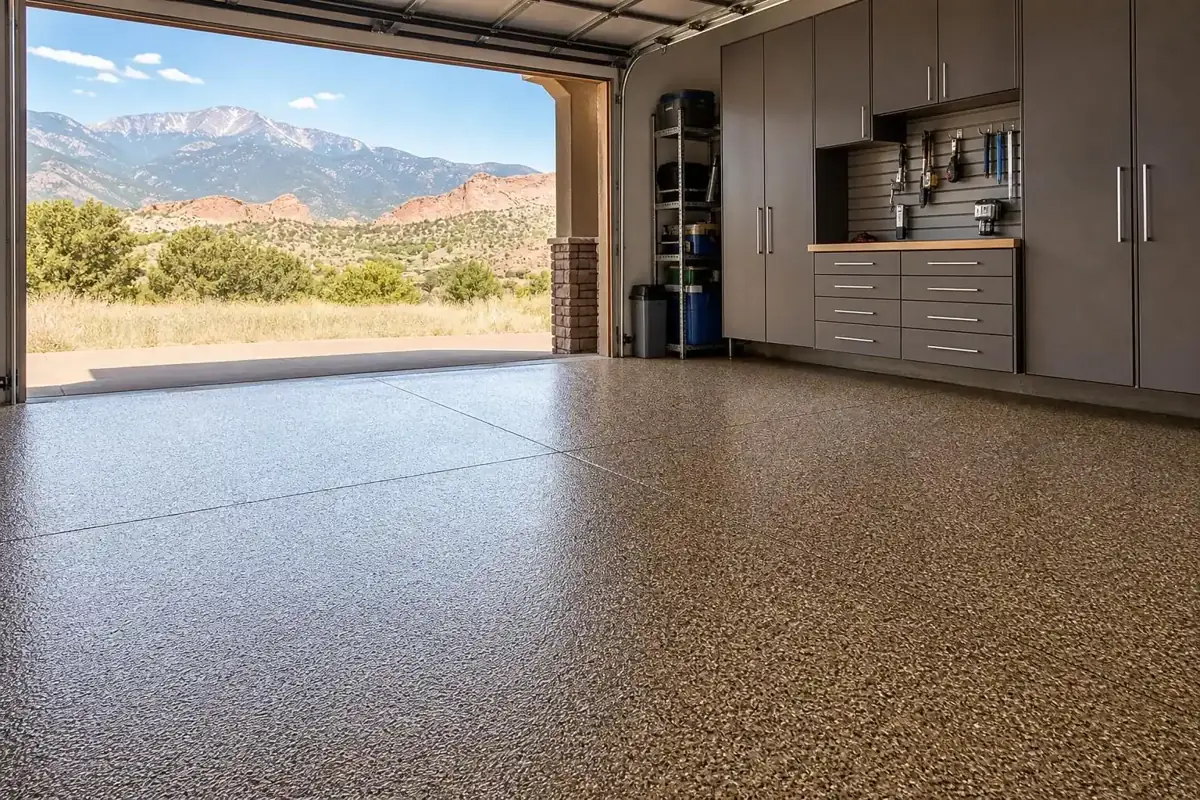
A good garage floor coating in Colorado Springs starts with the slab, not the color chart. Professionals check moisture, cracks, old sealers and surface hardness, then diamond grind and repair before applying an epoxy or polyaspartic system with a UV-stable topcoat that stands up to snow, de-icers and strong high-altitude sun.
Why the Slab Inspection Comes First
Most garage coating failures are not product failures. They are preparation failures. Before recommending a system, an experienced installer spends time on the concrete itself, because what is underneath decides how long the finish lasts.
At roughly 6,000 feet, Colorado Springs garages deal with intense sunlight, temperature swings and snowmelt carrying road treatment chemicals. A coating that is bonded to a weak or contaminated surface will lift under those stresses.
The Six Checks Pros Make Before Coating
- Moisture. A simple plastic-sheet test or a calcium chloride or relative humidity test shows whether vapor is moving through the slab. High moisture calls for a mitigating primer.
- Existing sealers or paint. Water beading on the surface often means a sealer is present. It has to be ground off for a coating to bond.
- Oil and fluid contamination. Deep oil stains may need degreasing, grinding and sometimes an oil-tolerant primer.
- Cracks and control joints. Installers note whether cracks are moving or stable and plan the right filler.
- Surface hardness and scaling. Soft, dusty or salt-scaled concrete needs extra grinding and patching.
- Drainage and slope. Garages slope toward the door. Low spots that hold water should be identified before coating.
Why these checks matter
Each issue changes the scope and price. A contractor who quotes without looking at the slab is guessing.
Choosing a Coating System for the Pikes Peak Region
Most quality garage floors in the region use a hybrid system: a 100%-solids epoxy base coat for bond and build, a decorative flake broadcast, and a polyaspartic or urethane clear topcoat for UV stability and abrasion resistance.
| System | Strengths | Considerations |
|---|---|---|
| Epoxy base + flake + polyaspartic top | Strong bond, good build, UV-stable finish | Usually two days of installation |
| Full polyaspartic | Fast cure, UV-stable, works in cooler temperatures | Short working time; needs experienced crew |
| Solid-color epoxy with clear coat | Clean look, lower cost | Shows dust and scratches more than flake |
Our epoxy flooring page covers each system in more detail.
Weather, De-Icers and Coating Performance
Snow packed into wheel wells melts on the garage floor all winter. The >Colorado Department of Transportation describes using liquid de-icers such as magnesium chloride on state highways, and that brine ends up on garage slabs. On bare concrete, repeated wetting and freezing combined with chlorides can lead to surface scaling.
A continuous coating keeps that brine on the surface. A slight texture from the flake broadcast or an anti-slip additive helps with footing when the floor is wet.
Installation temperature
Cold slabs slow curing. Manufacturers list minimum application temperatures on their data sheets, and installers may use heaters or faster-curing polyaspartic products in late fall.
Typical Costs in Colorado Springs
As a typical Front Range estimate for 2026, a professional flake system in a Colorado Springs garage usually runs about $5 to $8 per square foot including grinding and minor crack repair. Heavy repairs, moisture mitigation and metallic finishes cost more.
- Two-car garage, about 450 square feet: roughly $2,250 to $3,600 for a flake system
- Three-car garage, about 700 square feet: roughly $3,500 to $5,600
- Stem walls and steps: often priced separately by linear foot
The >Portland Cement Association offers background on how concrete quality affects durability, which is useful context when you look at an older slab.
Caring for a Coated Garage Floor Through Winter
A quality coating makes winter much easier, but a little maintenance keeps it looking new for years.
Simple winter routine
- Squeegee standing meltwater toward the door after storms instead of letting it evaporate and leave salt residue.
- Rinse the floor with clean water every few weeks during the de-icer season.
- Use a pH-neutral cleaner and a soft microfiber mop. Avoid citrus or acid cleaners that can dull some topcoats.
- Place mats under the tires only if they are designed for coated floors. Some rubber mats can stain.
Watch for early warning signs
Small chips from dropped tools can be touched up. A coating that lifts in sheets or bubbles across a wide area usually points to a moisture or preparation issue and should be evaluated by the installer.
Plan a refresh, not a replacement
Topcoats wear before base coats. After several years of heavy use, many floors can be lightly sanded and recoated with a new clear topcoat, which restores gloss at a fraction of the cost of a new system. Ask your installer whether your system is designed to be recoated.
Why Colorado Springs Property Owners Choose True Finishing
True Finishing has prepared, repaired and finished concrete floors across the Colorado Front Range and mountain towns since 2007. Our crews work in Colorado Springs and nearby communities, and we handle every step ourselves: moisture testing, grinding, crack and joint repair, and the final finish. That one-stop approach means nobody hands off a slab they did not prepare.
In Colorado Springs we see everything from new builds on the north side to older slabs with decades of oil and sealer buildup, and we adjust prep and product choice to each one. You can see how we approach larger jobs in our commercial case studies.
Ready to talk about your floor? Request a free estimate or call 303-761-1012. We will look at the slab, test it, and give you a written scope with clear pricing.
Frequently Asked Questions
What is the best garage floor coating for Colorado Springs?
For most homes, a hybrid system works best: a 100%-solids epoxy base, a full flake broadcast and a UV-stable polyaspartic topcoat. It bonds well, hides dirt, resists de-icing brine and holds its color in strong high-altitude sun. Full polyaspartic systems are also a good choice when fast turnaround matters.
How much does a garage floor coating cost in Colorado Springs?
As a typical Front Range estimate for 2026, professional flake coatings usually cost about $5 to $8 per square foot, or around $2,250 to $3,600 for a two-car garage. Slab repair, moisture mitigation, stem walls and specialty finishes add to the total, so an on-site evaluation is the best way to get an accurate price.
Do I need to grind my garage floor before coating?
Yes. Diamond grinding removes weak surface paste, old sealers and contaminants and creates a profile the coating can grip. Acid etching alone is less consistent and does not remove sealers. Most coating manufacturers specify mechanical preparation for their professional systems, and skipping it is a common reason coatings peel.
Can garage floors be coated in winter in Colorado Springs?
Often yes, as long as the slab and air temperature meet the product requirements. Installers may warm the garage with heaters and use faster-curing polyaspartic coatings. Very cold stretches can push a project back a few days, so scheduling in fall or during a mild winter window is common.
Does True Finishing serve Colorado Springs?
Yes. True Finishing installs garage floor coatings, epoxy and polished concrete in Colorado Springs and across the Front Range. We inspect and test the slab, then provide a written scope and price. Call 303-761-1012 or use our contact page to request a free estimate.