
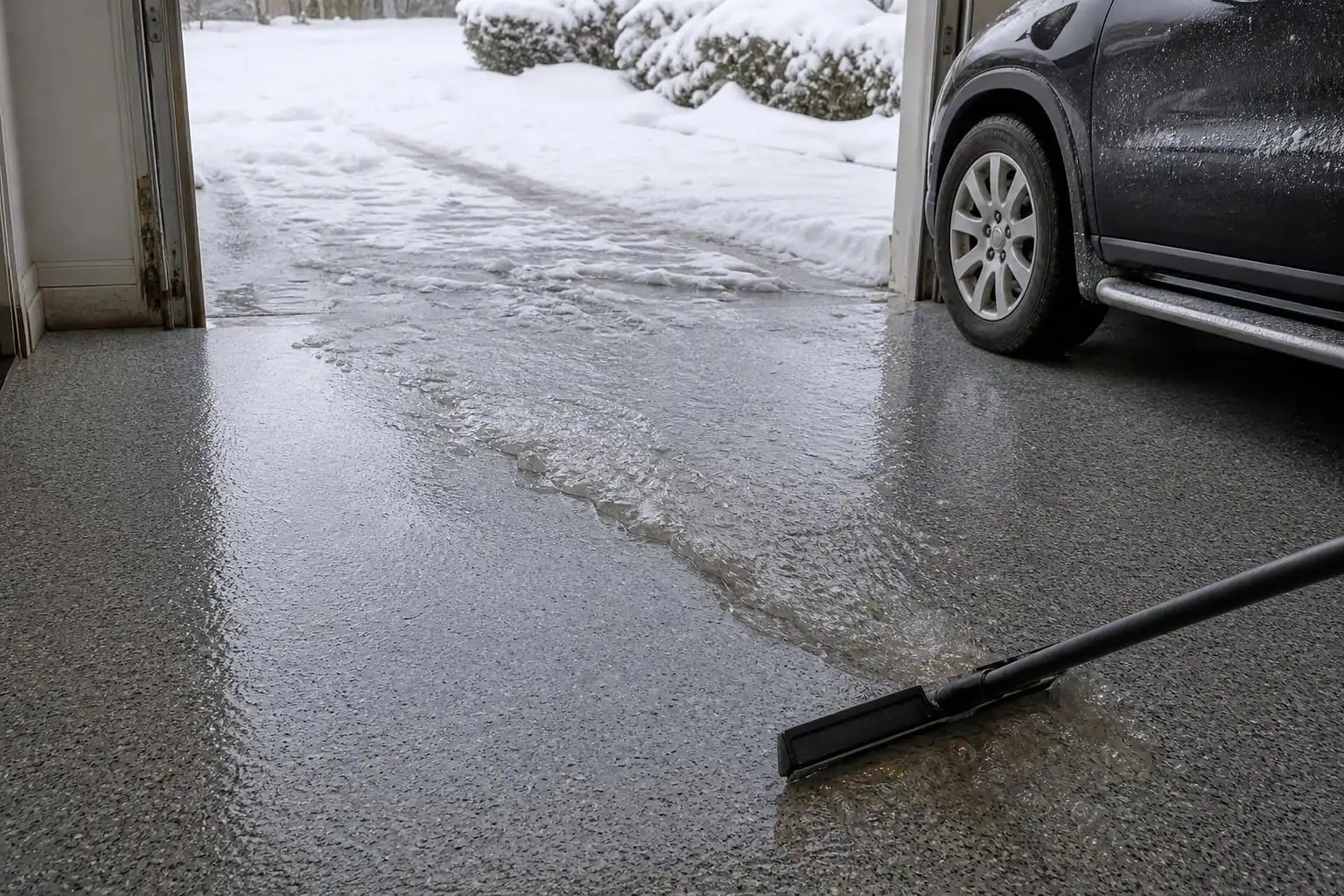
Magnesium chloride and other road de-icers drip off cars onto garage floors all winter. On bare concrete, repeated wetting, freezing and chloride exposure can contribute to surface scaling, pitting and white stains. Rinsing the floor, sealing or coating the slab, and repairing damage before it spreads are the best ways to protect a Colorado garage.
Why Colorado Garages Take a Beating Every Winter
Colorado roads are treated with liquid and solid de-icers during storms. The >Colorado Department of Transportation describes its use of liquid de-icers, including magnesium chloride, on state highways. That brine clings to tires and wheel wells and melts off onto the garage floor every evening.
Inside, the slab goes through repeated wet and dry cycles. Near the garage door, it may also freeze and thaw. That combination is tough on bare concrete, especially older or poorly finished slabs.
What the damage looks like
- Scaling: the top layer flakes off, exposing rough sand and stone.
- Pitting and popouts: small craters where weak surface material has broken loose.
- White residue: salt and mineral deposits left after water evaporates.
- Stains and darkening along tire paths and under parked vehicles.
How De-Icers Contribute to Concrete Damage
Concrete is porous. Water carrying dissolved chlorides soaks into the surface. When temperatures drop, the water in the pores freezes and expands, creating internal pressure. Chloride solutions can increase the number of wet freeze-thaw cycles the surface sees and leave salt crystals behind as water evaporates. Over time, this weakens the paste at the top of the slab.
The >Portland Cement Association identifies freeze-thaw exposure and de-icing chemicals as major causes of surface scaling, especially on concrete that was not properly air-entrained, finished or cured. Many garage slabs were never designed for heavy exposure, which is why damage often starts right where vehicles park.
Rebar and deeper concerns
In structural slabs, chlorides can eventually reach reinforcing steel and cause corrosion. Most residential garage slabs on grade are less vulnerable, but cracks that let brine soak deep should still be sealed.
Prevention: Simple Habits That Help
- Squeegee meltwater out of the garage after storms instead of letting it evaporate.
- Rinse the floor with clean water every few weeks in winter to flush salt.
- Knock packed snow out of wheel wells outside the garage when practical.
- Use containment mats designed for snow and slush under each vehicle.
- Keep the floor drain clear if you have one.
These habits slow damage on bare concrete and keep coated floors looking clean.
Sealers vs. Coatings for De-Icer Protection
| Option | How it protects | Lifespan and limits |
|---|---|---|
| Penetrating sealer (silane/siloxane) | Repels water inside the pores | Invisible; needs reapplication every few years |
| Acrylic sealer | Thin surface film | Wears quickly under tires; frequent recoats |
| Epoxy and polyaspartic coating | Continuous, non-porous barrier | Long-lasting with proper prep; easy to clean |
A full coating system with a flake broadcast keeps brine on top of the floor where it can be squeegeed away. See our epoxy flooring page for system options.
Repairing a Scaled or Pitted Garage Floor
Damaged concrete can usually be restored without tearing out the slab. The usual process looks like this:
- Diamond grind to remove loose, weak surface material and salt contamination.
- Rinse and test to confirm contaminants are removed where needed.
- Patch pits and scaled areas with a repair mortar or epoxy-based patch.
- Fill cracks and joints.
- Apply a coating system or an overlay, depending on the depth of damage.
For widespread scaling, a polymer-modified concrete overlay can rebuild the surface before coating.
When to Fix It: Timing in Colorado
Repairing damage before another winter matters, because each season of exposure deepens scaling. Many coatings can be installed in cool weather with heaters and fast-curing products, so late fall projects are common. If your floor is already wet and salty, the crew will clean and dry it before work begins.
Signs it is time to call a pro
- Scaling has spread beyond a small patch near the door.
- Pits are deep enough to hold water.
- An old DIY coating is peeling in the parking areas.
- Cracks are getting wider each spring.
What a repair visit includes
On a typical Lakewood garage, the estimate visit includes a look at the depth of scaling, a check for old sealers, a simple moisture check and a review of cracks and the drain area. You get a written scope that separates repair work from the coating itself, so you can see exactly what you are paying for.
Protecting driveways and aprons too
The exterior apron in front of the garage door often shows damage first because it sees direct snow, plowing and the most de-icer. While interior coatings are not designed for exterior aprons, a quality penetrating sealer on the driveway and prompt snow removal help keep the damage from creeping inside. Avoid spreading de-icers on concrete that is less than a year old, since young concrete is more vulnerable to scaling.
Why Lakewood Property Owners Choose True Finishing
True Finishing has prepared, repaired and finished concrete floors across the Colorado Front Range and mountain towns since 2007. Our crews work in Lakewood and nearby communities, and we handle every step ourselves: moisture testing, grinding, crack and joint repair, and the final finish. That one-stop approach means nobody hands off a slab they did not prepare.
Lakewood garages see heavy winter traffic from foothills commutes, so we pay special attention to scaled concrete, drain areas and the front edge of the slab where de-icer exposure is worst. You can see how we approach larger jobs in our commercial case studies.
Ready to talk about your floor? Request a free estimate or call 303-761-1012. We will look at the slab, test it, and give you a written scope with clear pricing.
Frequently Asked Questions
Does mag chloride damage concrete garage floors?
Magnesium chloride brine tracked in on tires can contribute to scaling, pitting and staining on bare concrete, especially combined with freeze-thaw cycles near the garage door. Older or poorly finished slabs are most vulnerable. Rinsing salt off regularly and protecting the slab with a sealer or coating greatly reduces damage.
What is the best way to protect a garage floor from road salt?
A professionally installed epoxy and polyaspartic coating gives the most complete protection because it forms a continuous, non-porous barrier. Penetrating sealers are a lower-cost option that repels water but needs reapplication. In either case, squeegeeing meltwater and rinsing the floor during winter helps a lot.
Can a scaled garage floor be repaired?
Yes. Most scaled garage floors can be restored by grinding off weak material, patching pits, filling cracks and applying a coating or overlay. Full replacement is rarely necessary unless the slab is structurally failing. Repairs are best done before another winter adds more damage.
How do I clean mag chloride residue off my garage floor?
Sweep up grit, then scrub with warm water and a pH-neutral cleaner and rinse thoroughly. Repeat rinsing for stubborn white film. Squeegee water out so it does not evaporate and leave new residue. Avoid harsh acids, which can damage concrete and some coatings.
Does True Finishing repair salt-damaged garage floors?
Yes. True Finishing grinds, patches and coats salt-damaged garage floors in Lakewood and across the Front Range. We assess how deep the damage goes and recommend a coating or overlay accordingly. Call 303-761-1012 for a free estimate.