
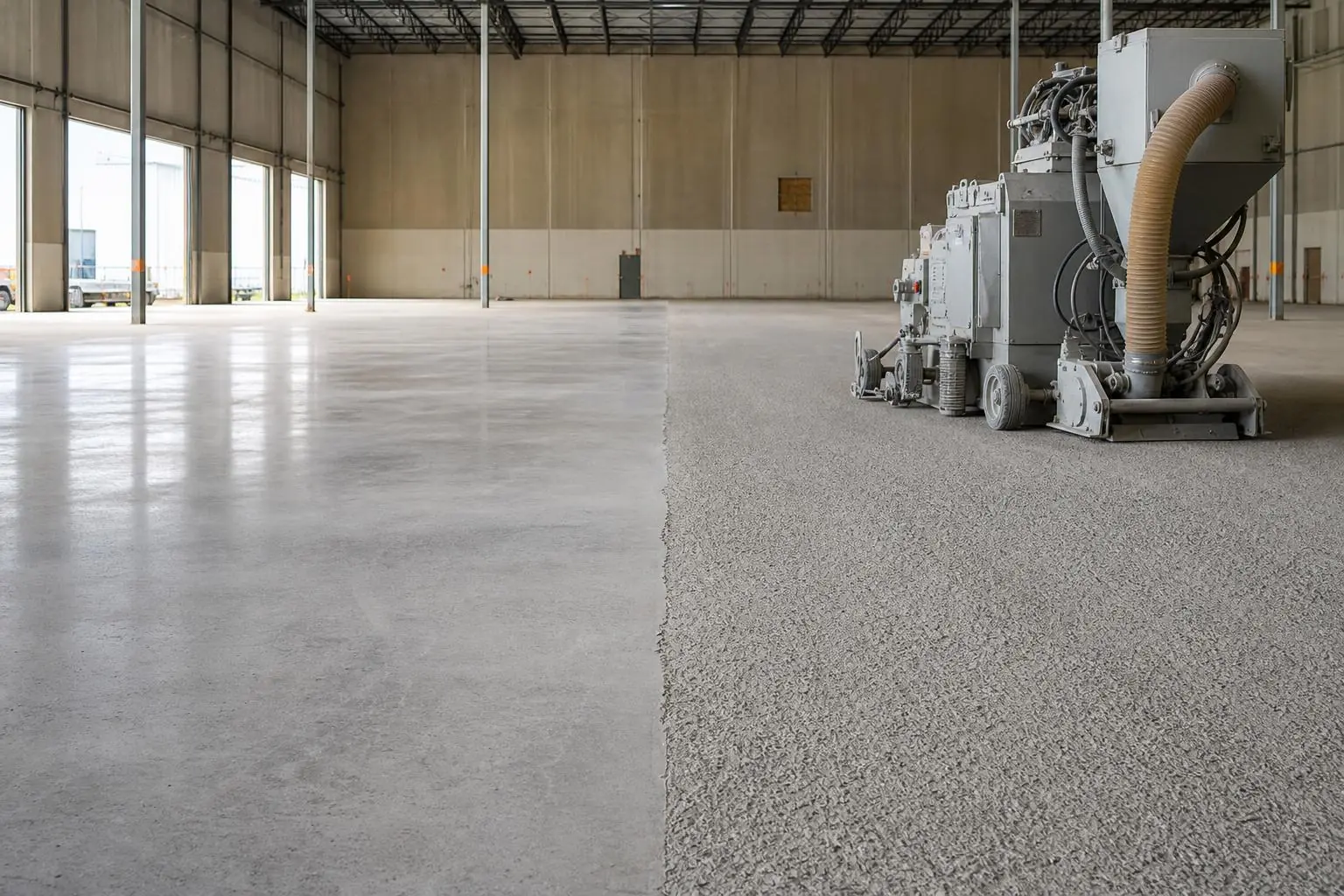
Concrete surface profile, or CSP, describes how rough a prepared slab is, on a scale from CSP 1 (nearly flat) to CSP 10 (very rough). Thin coatings need a light profile, often CSP 2 to 3, while thick overlays and mortars need more. Diamond grinding, shot blasting and scarifying each create different profiles, so the method should match the system.
What Is Concrete Surface Profile (CSP)?
Concrete surface profile is a standardized way to describe the texture of prepared concrete. The industry scale runs from CSP 1, a nearly flat surface like an acid-etched slab, to CSP 10, a very rough surface like heavy scabbling. Contractors compare their prepared slab to reference chips that show each profile level.
The profile matters because coatings and overlays bond mechanically. Too smooth, and a thick material has nothing to grip. Too rough, and a thin coating cannot cover the peaks, leaving pinholes and weak spots.
Matching Profile to the Floor System
| System | Typical thickness | Typical profile |
|---|---|---|
| Sealers and densifiers | Penetrating | CSP 1 to 2 |
| Thin film coatings | Up to about 10 mils | CSP 1 to 3 |
| High-build epoxy | About 10 to 40 mils | CSP 2 to 4 |
| Self-leveling and slurry | About 1/16 to 1/4 inch | CSP 3 to 5 |
| Polymer overlays and mortars | 1/4 inch and up | CSP 4 to 7+ |
Always follow the coating manufacturer’s specified profile, which is part of their warranty requirements.
Diamond Grinding
Diamond grinders use rotating heads with metal-bond diamond segments. They are the most common prep method for residential and commercial coatings.
Strengths
- Removes thin coatings, sealers, adhesives and weak surface paste
- Produces a consistent CSP 1 to 3 profile, ideal for coatings
- Can flatten ridges and high spots
- Works close to walls with edge grinders
Limitations
Slower on very large open areas and less effective for creating deep profiles for thick overlays.
Shot Blasting
Shot blasters propel small steel shot at the concrete, then recycle the shot and collect dust in a connected vacuum. They are fast on large open floors.
Strengths
- Very productive on warehouses and parking decks
- Produces CSP 3 to 5 depending on shot size and speed
- Opens the surface well for thicker systems
Limitations
Can leave “tracking” lines visible under thin coatings, does not remove soft adhesives well, and cannot reach edges, which still need grinding.
Scarifying and Other Methods
Scarifiers, also called planers, use rotating cutters to chip the surface aggressively. They remove thick coatings and create deep profiles of CSP 5 to 9 for heavy overlays. Hand tools like needle scalers handle small areas. Acid etching creates only a CSP 1 profile and does not remove sealers, so most manufacturers do not accept it for professional coatings.
Every mechanical method generates silica dust. >OSHA’s silica standard requires dust controls such as vacuum extraction for grinding and similar tasks.
How Pros Verify the Profile
- Compare the prepared slab with standardized CSP reference chips.
- Check for remaining contamination, such as water beading on sealer residue.
- Perform pull-off adhesion tests on critical commercial work.
- Vacuum and inspect before primer, especially at edges and joints.
The >American Concrete Institute publishes guidance on surface preparation for repairs and overlays that engineers often reference in specifications. Our floor preparation page describes how we document prep on each job.
Choosing the Right Method for Your Project
For a residential garage or basement coating, diamond grinding is almost always the right choice. For a large warehouse getting a thicker epoxy slurry, shot blasting plus edge grinding is efficient. For removing thick old coatings or preparing for a heavy overlay, scarifying may be needed. Many projects combine methods.
Questions to ask your contractor
- What profile does the specified system require?
- Which method will you use, and why?
- How will edges, corners and joints be prepared?
- How will dust be controlled?
Common prep problems we fix
Many of the failed floors we are called to repair trace back to a mismatch between profile and product. Thin coatings over shot-blasted slabs show tracking lines and pinholes. Thick overlays over lightly ground slabs delaminate in sheets. Coatings over etched floors peel where old sealer was never removed. In each case, the fix starts by removing the failed material and preparing the slab to the profile the new system actually requires.
Prep for polished concrete
Polished concrete is a special case. There is no coating to bond, so the goal is not a rough profile but a flat, uniform surface. Grinding progresses from coarse metal-bond diamonds to fine resin pads, refining the scratch pattern at each step rather than leaving texture behind. Choosing the wrong starting grit wastes time, and skipping steps leaves scratches that show under gloss, so profile thinking still matters even when nothing is being applied on top.
Why Thornton Property Owners Choose True Finishing
True Finishing has prepared, repaired and finished concrete floors across the Colorado Front Range and mountain towns since 2007. Our crews work in Thornton and nearby communities, and we handle every step ourselves: moisture testing, grinding, crack and joint repair, and the final finish. That one-stop approach means nobody hands off a slab they did not prepare.
We prepare slabs in Thornton warehouses, schools and homes with grinders, shot blasters and scarifiers, and choose the method based on what is going on the floor next. You can see how we approach larger jobs in our commercial case studies.
Ready to talk about your floor? Request a free estimate or call 303-761-1012. We will look at the slab, test it, and give you a written scope with clear pricing.
Frequently Asked Questions
What is CSP in concrete prep?
CSP stands for concrete surface profile, a scale from 1 to 10 that describes the roughness of prepared concrete. Contractors compare prepared slabs to standardized reference chips. Coating and overlay manufacturers specify the CSP needed for proper bond, with thin coatings needing lower profiles and thick systems needing higher ones.
Is grinding or shot blasting better for epoxy?
For most residential and thin commercial epoxy systems, diamond grinding is preferred because it creates a consistent CSP 1 to 3 profile and removes sealers and adhesives. Shot blasting is efficient for large open floors and thicker systems but can leave visible patterns under thin coatings.
Can I acid etch instead of grinding?
Acid etching creates only a very light profile and does not remove sealers, paint or many contaminants. Most professional coating manufacturers require mechanical preparation such as grinding or shot blasting for their warranties. Etching also creates acidic waste that must be neutralized and disposed of properly.
What profile does a concrete overlay need?
Polymer-modified overlays and mortars typically need a rougher profile, often CSP 4 to 7 depending on thickness and product. Shot blasting or scarifying is usually used to achieve it. Always confirm the required profile in the overlay manufacturer installation instructions.
Does True Finishing do floor prep for other trades?
Yes. True Finishing grinds, shot blasts and scarifies slabs for flooring installers, general contractors and facility owners in Thornton and across the Front Range. We match the profile to the system going down. Call 303-761-1012 or request a free estimate.