
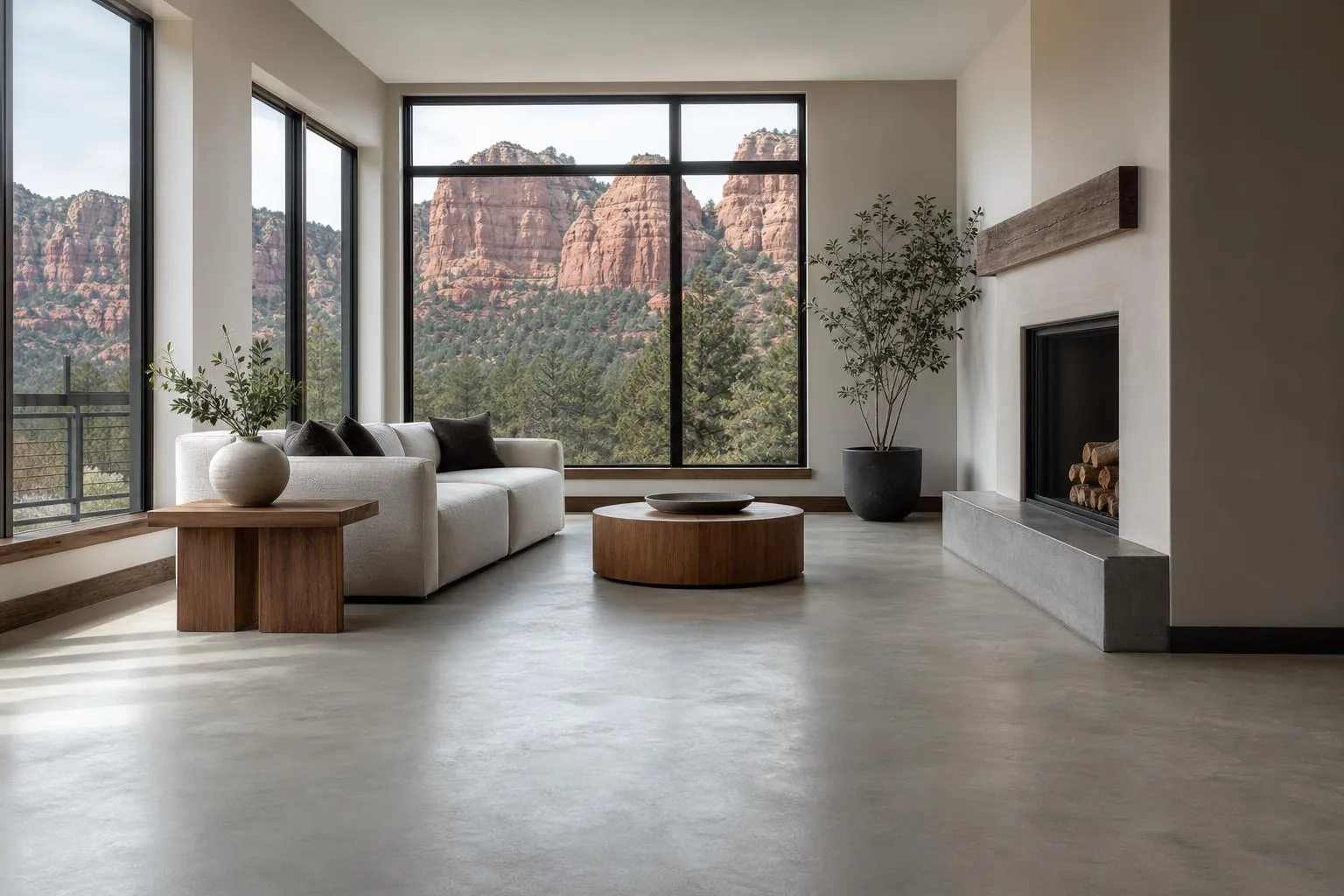
Microcement is a thin, polymer-modified cement coating, usually 2 to 3 millimeters thick, applied by trowel over concrete, tile and other stable surfaces to create a seamless concrete look. It works well in living areas, bathrooms, retail and stairs, but needs a sound substrate, skilled application and a quality sealer to resist stains and wear.
What Is Microcement?
Microcement, also called micro-cement or microtopping, is a blend of fine cement, aggregates, polymers and pigments. It is troweled in thin layers, typically a few millimeters total, and then sealed. Because it is so thin, it can go over existing surfaces like concrete, ceramic tile and some boards without raising floor height much or requiring demolition.
The finished look is a smooth or subtly textured, seamless surface with natural variation from the trowel. It can be applied to floors, walls, showers, countertops and stairs. Our microtopping and micro-cement floors page shows how we use it.
Pros of Microcement Floors
- Seamless look: no grout lines, which makes small rooms feel larger and is easy to clean.
- Thin build: usually no need to adjust doors, cabinets or transitions.
- Less demolition: often installed over existing tile after preparation.
- Design flexibility: many colors and finishes from matte to satin.
- Continuity: the same finish can run from floors to walls and showers.
- Works with radiant heat: thin layers transfer heat well when installed per manufacturer instructions.
Cons and Limitations
- Substrate sensitivity: movement or cracks in the base can telegraph through.
- Skill-dependent: results vary greatly by applicator; troweling is a craft.
- Sealer is essential: unsealed or poorly sealed microcement stains easily.
- Scratch potential: grit and pet claws can mark softer sealers.
- Not for heavy industrial use: forklifts and heavy impact call for thicker systems.
Hairline cracking
Some fine cracking can appear over joints or flexible substrates. Good prep, mesh reinforcement where specified and honoring structural joints reduce this risk.
Microcement vs. Polished Concrete vs. Epoxy
| Factor | Microcement | Polished concrete | Epoxy |
|---|---|---|---|
| Look | Hand-troweled, artisan | Natural stone and cream | Uniform, glossy or decorative |
| Thickness | About 2 to 3 mm | Slab itself | Mils to 1/4 inch |
| Over tile | Yes, with prep | No | Sometimes |
| Walls and showers | Yes | No | Limited |
| Durability | Good with proper sealer | Excellent | Very good |
How Microcement Is Installed
- Assess and repair the substrate, filling cracks and leveling where needed.
- Grind or clean the surface and apply a bonding primer.
- Embed reinforcing mesh where the system calls for it.
- Trowel a base coat, then one or more finish coats, sanding between layers.
- Apply sealers, often a penetrating primer sealer and a protective topcoat.
- Allow cure time before furniture and regular traffic.
Indoor air matters during sealing. The >EPA’s indoor air quality resources recommend ventilation when using products that release VOCs, and many microcement sealers now come in low-VOC water-based versions.
Where Microcement Works Best
Great fits
- Living rooms, kitchens and hallways in modern homes
- Bathrooms and walk-in showers, with a waterproofing system beneath
- Boutique retail, restaurants and offices with moderate traffic
- Stairs and feature walls
Poor fits
- Garages with hot tires and road salt
- Warehouses and heavy industrial floors
- Substrates that flex or move significantly
Cost and Care
As a typical Front Range and mountain estimate for 2026, professionally installed microcement floors range from about $12 to $25 per square foot depending on prep, design and number of coats. Mountain projects can include travel and logistics costs. Care is simple: sweep grit, clean with pH-neutral products, and refresh the sealer as recommended. The >American Concrete Institute provides general background on cementitious materials and repairs that supports good microtopping practice.
Mountain home considerations
In Glenwood Springs, Carbondale and other mountain communities, microcement is popular in entries, great rooms and bathrooms because it complements stone, timber and steel. A few practical points help it perform at altitude:
- Keep the home heated to the manufacturer’s application range during install and cure, since winter shells can be cold.
- Choose a durable, scratch-resistant topcoat for entries that see ski boots, gravel and snowmelt.
- Add generous walk-off mats at doors to trap grit before it reaches the floor.
- Plan around radiant heat systems, turning heat down during installation per product instructions.
Choosing an installer
Ask to see completed microcement floors in person, not just photos online, and ask which product system and sealer will be used. A reputable installer explains how they will deal with joints and substrate movement, and provides written care instructions for the sealer they apply. It is also worth asking how they handle color consistency between batches on large floors, how they protect adjacent finishes like cabinetry and stone during sanding, and how long you should wait before placing area rugs or heavy furniture, since some sealers need extra time to cure under coverings.
Why Glenwood Springs Property Owners Choose True Finishing
True Finishing has prepared, repaired and finished concrete floors across the Colorado Front Range and mountain towns since 2007. Our crews work in Glenwood Springs and nearby communities, and we handle every step ourselves: moisture testing, grinding, crack and joint repair, and the final finish. That one-stop approach means nobody hands off a slab they did not prepare.
From Glenwood Springs to the Roaring Fork Valley and the Front Range, we install microcement and microtoppings in homes and businesses where clients want a seamless concrete look without pouring new slab. You can see how we approach larger jobs in our commercial case studies.
Ready to talk about your floor? Request a free estimate or call 303-761-1012. We will look at the slab, test it, and give you a written scope with clear pricing.
Frequently Asked Questions
Is microcement good for floors?
Yes, for residential and moderate-traffic commercial spaces. Microcement creates a seamless, attractive finish that is easy to clean when properly sealed. It needs a stable substrate and skilled application. It is not suited to garages with hot tires or heavy industrial traffic, where thicker coatings or polished concrete perform better.
Can microcement be applied over tile?
Often yes. Existing tile must be firmly bonded, cleaned and prepared, and grout lines are filled so they do not show through. A bonding primer and sometimes reinforcing mesh are used. Loose or cracked tiles should be removed and patched first, since movement will telegraph into the thin microcement layer.
How long does a microcement floor last?
With a quality sealer and regular care, microcement floors can last many years in homes. The sealer takes daily wear and may need refreshing every few years in high-traffic areas. Durability depends on application quality, substrate stability and maintenance, so choosing an experienced installer matters.
Is microcement waterproof?
Sealed microcement is water-resistant and works in bathrooms and showers when installed over a proper waterproofing membrane. The microcement itself is not a waterproofing system. Showers and wet rooms should have a dedicated membrane beneath, and sealers must be maintained to keep water and stains from penetrating.
Does True Finishing install microcement in Glenwood Springs?
Yes. True Finishing installs microcement and microtopping floors in Glenwood Springs, the mountain towns and across the Front Range. We prep the substrate, apply and seal the finish. Call 303-761-1012 or request a free estimate through our contact page.