
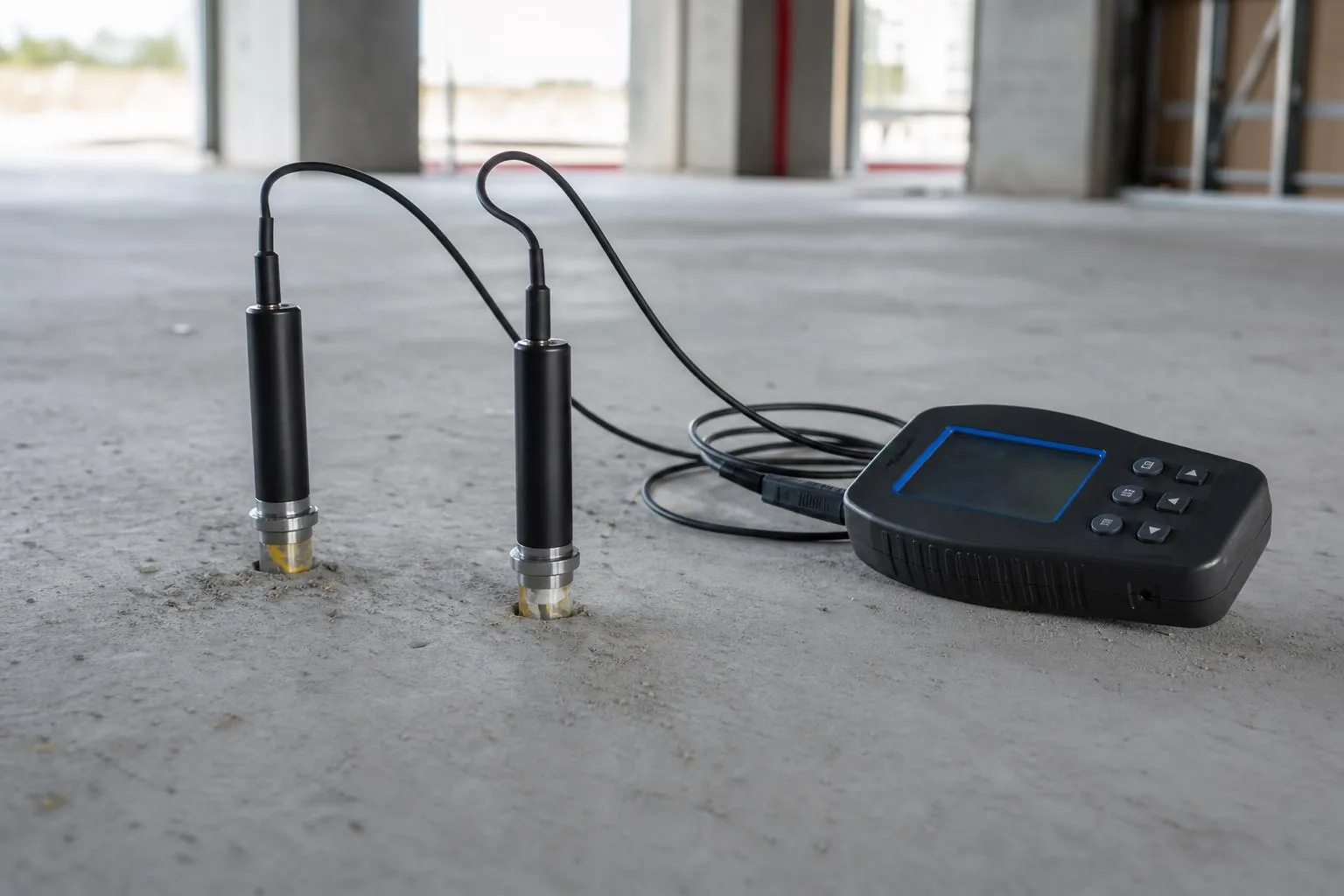
Concrete moisture testing measures how much water a slab holds or releases before flooring or coatings go down. ASTM F2170 uses relative humidity probes placed inside drilled holes, while ASTM F1869 measures moisture vapor emission at the surface with calcium chloride. Results are compared with the flooring manufacturer limits to decide if mitigation is needed.
Why Concrete Moisture Matters for Floors
Concrete is made with more water than the cement needs to harden, and the extra water leaves slowly over months. Slabs on grade can also pick up moisture from the ground. When a vapor-tight floor covering or coating is placed over a slab with high moisture, that vapor gets trapped. The result can be adhesive failure, blistering coatings, curling tile, mold and musty odors.
Moisture-related flooring failures are among the most expensive problems in commercial construction because they often appear months after the building opens. Testing first costs a fraction of tearing out a failed floor.
ASTM F2170: In-Situ Relative Humidity Testing
>ASTM F2170 measures the relative humidity inside the concrete. Small holes are drilled to a specified depth, typically 40% of slab thickness for slabs drying from one side, sleeves are inserted, and probes are allowed to equilibrate before readings are taken.
Why many manufacturers prefer RH testing
- It reflects moisture conditions deeper in the slab, which is what the floor will experience once sealed.
- It is less affected by surface conditions and short-term room humidity.
- Results are reported as a simple percentage, often with limits like 75%, 80%, 85% or 90% RH depending on the product.
Test conditions
The building should be at service conditions, with HVAC running, for the standard’s specified time before testing. Testing a cold, unconditioned shell gives misleading results.
ASTM F1869: Calcium Chloride Testing
>ASTM F1869 measures the moisture vapor emission rate (MVER) from the surface. A dish of calcium chloride is sealed under a plastic dome on a prepared area of concrete for 60 to 72 hours, then weighed to see how much moisture it absorbed. Results are reported in pounds per 1,000 square feet per 24 hours.
Many resilient flooring and adhesive manufacturers historically used limits of 3 to 5 pounds. The test only reflects the top portion of the slab and is sensitive to surface prep and ambient conditions, which is why some manufacturers now favor RH testing or require both.
Comparing the Two Methods
| Factor | ASTM F2170 (RH probes) | ASTM F1869 (calcium chloride) |
|---|---|---|
| What it measures | Relative humidity within the slab | Vapor emission at the surface |
| Result units | % RH | lbs/1,000 sq ft/24 hrs |
| Test duration | Probes equilibrate per the standard (often 24 hours) | 60 to 72 hours |
| Sensitivity to surface | Low | High |
| Common use | Flooring adhesives, resilient, coatings | Legacy specs, some coatings |
Quick tests like taping plastic sheet to the floor (ASTM D4263) only show whether moisture is obviously present. They are not a substitute for quantitative testing.
How Many Tests Do You Need?
ASTM F2170 calls for a minimum number of test locations based on floor area, with three tests for the first 1,000 square feet and additional tests for each additional 1,000 square feet. Locations should include exterior walls, areas near plumbing and any suspect spots. A single reading in the middle of a room does not tell the whole story.
- Test after the building is enclosed and conditioned.
- Record ambient temperature and humidity.
- Map locations on a floor plan.
- Keep the report with project closeout documents.
What If the Slab Fails the Test?
When results exceed the flooring or coating manufacturer’s limits, there are three main paths:
- Wait. If time allows and the source is construction water, the slab may dry, though thick slabs on grade can take many months.
- Mitigate. Apply a moisture vapor mitigation system, often a 100%-solids epoxy primer rated for high RH, followed by a cement-based underlayment if needed. See our concrete moisture mitigation service.
- Change the flooring. Some flooring products and adhesives tolerate higher moisture levels.
Mitigation is often the fastest path on commercial schedules, and it protects the floor for its full life rather than only the first season.
Moisture Testing in Colorado
Colorado’s dry air helps exposed slabs dry from the top, but it does not change moisture coming up from the ground beneath a slab on grade. Basements, buildings without an effective vapor retarder, and sites with irrigation or poor drainage can show high readings even in the semi-arid Front Range. Testing removes the guesswork. Our floor preparation process includes moisture checks before any coating is applied.
Who should run the test?
Testing should be done by someone trained in the standard, with calibrated probes and a written report. Many flooring warranties require documented results, so keep copies with your project records.
Why Broomfield Property Owners Choose True Finishing
True Finishing has prepared, repaired and finished concrete floors across the Colorado Front Range and mountain towns since 2007. Our crews work in Broomfield and nearby communities, and we handle every step ourselves: moisture testing, grinding, crack and joint repair, and the final finish. That one-stop approach means nobody hands off a slab they did not prepare.
We test slabs before every coating and leveling project in Broomfield and across the metro, and we install mitigation systems when the numbers call for it rather than hoping a floor will be fine. You can see how we approach larger jobs in our commercial case studies.
Ready to talk about your floor? Request a free estimate or call 303-761-1012. We will look at the slab, test it, and give you a written scope with clear pricing.
Frequently Asked Questions
What is ASTM F2170?
ASTM F2170 is the standard test method for determining relative humidity in concrete slabs using in-situ probes. Holes are drilled to a set depth, sleeves and probes are installed, and readings are taken after equilibration. Many flooring and adhesive manufacturers use F2170 results to decide whether a slab is ready for their products.
What is an acceptable moisture level for concrete before flooring?
It depends on the product. Many flooring and adhesive manufacturers list limits between 75% and 90% relative humidity under ASTM F2170, or 3 to 5 pounds per 1,000 square feet per 24 hours under ASTM F1869. Always follow the specific manufacturer installation requirements for warranty coverage.
How long does it take concrete to dry before flooring?
There is no reliable fixed timeline. Drying depends on slab thickness, mix design, vapor retarder, temperature, humidity and airflow. Older rules of thumb suggest about a month per inch of thickness under good conditions, but slabs on grade often take much longer. Testing is the only way to know.
Can epoxy fix a concrete moisture problem?
Specialized moisture vapor mitigation epoxies can be applied to slabs with high moisture to protect flooring above. Standard epoxy floor coatings are not designed for this and can blister. The mitigation system must be rated for the measured RH or MVER and installed over properly ground concrete.
Does True Finishing perform moisture testing?
Yes. True Finishing tests concrete moisture before coatings, leveling and flooring prep, and installs moisture mitigation systems for homes and commercial projects in Broomfield and across the Front Range. Call 303-761-1012 or request a free estimate to schedule testing.