
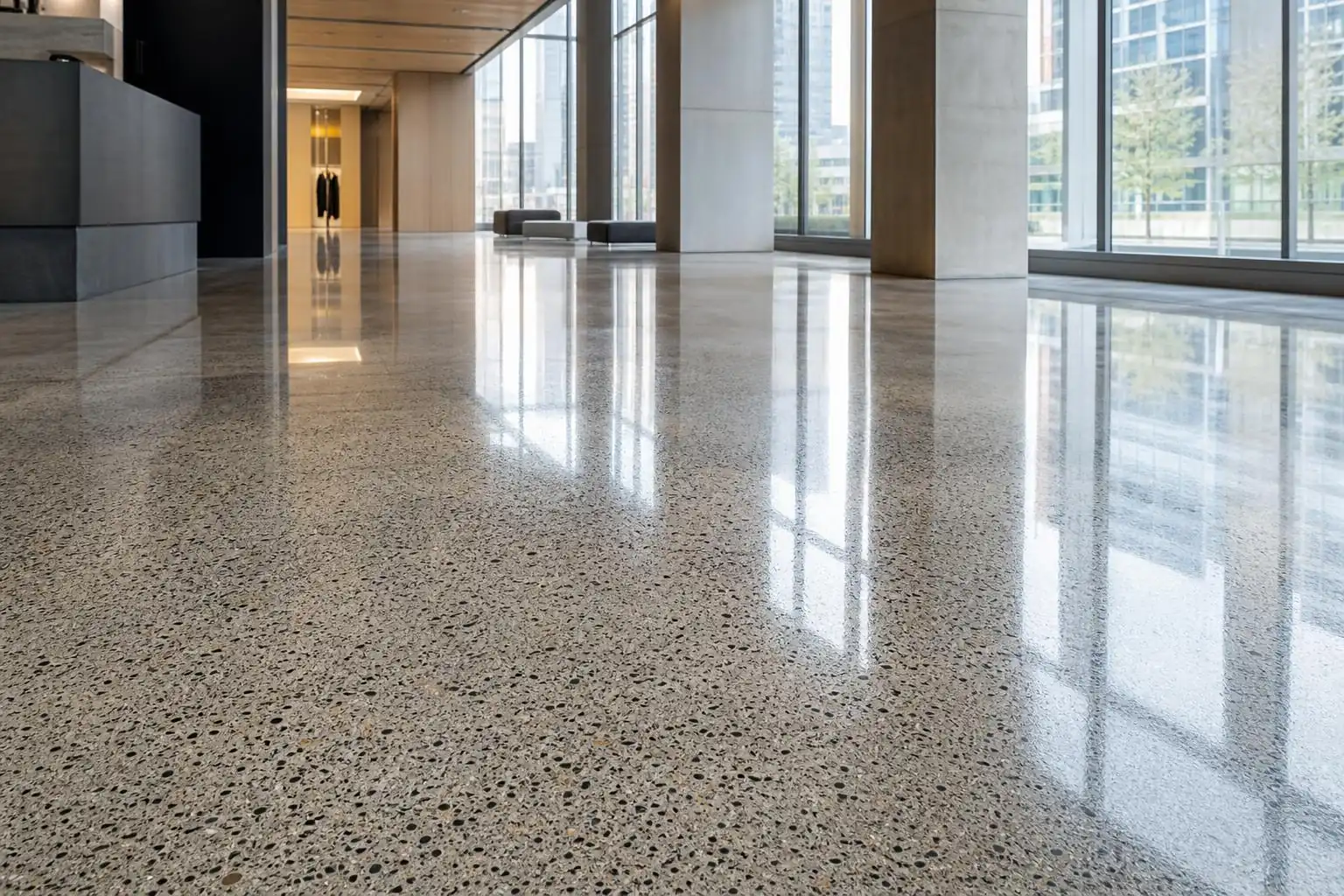
As a typical Front Range estimate for 2026, polished concrete in Denver costs about $3 to $8 per square foot for most commercial and residential floors, and $8 to $14 or more for decorative work with heavy aggregate exposure, dyes or extensive repairs. Slab condition, gloss level, size and existing coatings drive the final price.
Polished Concrete Prices at a Glance
Polished concrete pricing depends more on the existing slab than on the finish itself. The table below shows typical Front Range estimates for 2026 assuming normal access and a sound slab.
| Finish | Description | Typical cost per sq ft |
|---|---|---|
| Grind and seal / guard | Light grind, densifier, guard, low gloss | $2 to $4 |
| Cream polish | Minimal aggregate exposure, satin to semi-gloss | $3 to $6 |
| Salt and pepper | Fine aggregate exposed, semi to high gloss | $4 to $8 |
| Full aggregate exposure | Large stone exposed, high gloss | $6 to $12 |
| Decorative with dyes or patterns | Color, saw cuts, borders | $8 to $14+ |
Our concrete polishing page explains each finish in more detail.
What Drives the Cost of Polished Concrete?
Existing coverings and coatings
Removing carpet glue, tile mortar, VCT mastic or an old epoxy coating can take as much time as the polish itself. Some older black adhesives must be tested for asbestos before removal.
Slab hardness and condition
Hard, dense concrete takes longer to cut but polishes to a deep shine. Soft concrete cuts fast but needs densifier and care to reach gloss. Cracks, spalls, old patches and joint filler all add labor.
Level of aggregate exposure
The deeper the grind, the more stone is revealed and the more passes and tooling are required. Full aggregate exposure is the most expensive common finish because the crew removes significant surface material.
Gloss level
Each additional resin pad step adds time. A high-gloss floor costs more than a satin finish over the same slab.
Access and size
Large open floors allow ride-on or wide grinders. Small rooms with many edges require hand tools and cost more per square foot.
New Construction vs. Existing Slabs
The most cost-effective polished floors are planned before the concrete is placed. When the general contractor knows a slab will be polished, the pour, finishing and curing can be managed to produce a flat, uniform surface with consistent aggregate. Protecting that slab from trades during construction prevents stains from hydraulic fluid, paint and drywall mud.
Existing slabs can absolutely be polished, but they come with history: patches, cracks, stains and uneven finishing. Those characteristics show in the final floor, and some owners love that character while others prefer a coating.
Polished Concrete vs. Other Commercial Floors
- vs. VCT tile: polished concrete eliminates stripping and waxing cycles, which cuts long-term maintenance costs.
- vs. epoxy: polished concrete has no film to wear through or peel, but it does not hide slab flaws.
- vs. carpet tile or LVT: polished concrete lasts much longer and does not need periodic replacement.
Lifecycle cost is where polished concrete shines. Upfront price is similar to many coverings, while maintenance is simpler.
Hidden Costs and Line Items to Check
- Removal of existing flooring and adhesive
- Crack and joint filling, and whether joints are color-matched
- Edge and corner work along walls and cabinets
- Stain guard and its reapplication schedule
- Dust control and after-hours work in occupied buildings
- Protection of the finished floor from other trades
Grinding produces respirable crystalline silica, which is regulated by >OSHA’s silica standard, so dust extraction is part of every professional polishing quote.
Maintenance Costs After Installation
Routine care for polished concrete is simple: dust mop or auto-scrub with a neutral cleaner, and periodically burnish to restore gloss. Guards may be refreshed every year or two in busy areas. Compared with stripping and waxing tile, maintenance budgets are typically lower.
For industry definitions of grinding, densifying and polishing, the >American Concrete Institute provides technical resources used by specifiers and contractors.
How to Compare Polished Concrete Quotes
Ask each contractor to specify the aggregate exposure class, the final gloss level, the grit sequence, the densifier and guard products, and how joints and cracks will be treated. When those details match, price comparisons become meaningful. Ask to see a sample area or a completed floor with a similar slab so you can judge appearance before committing.
Ask for a test patch on large projects
On big floors, a small test area shows how the slab will look at your chosen exposure and gloss. It reveals hidden patches, color variation and aggregate distribution before the full scope is locked in, which protects both the owner and the contractor from surprises.
Why Denver Property Owners Choose True Finishing
True Finishing has prepared, repaired and finished concrete floors across the Colorado Front Range and mountain towns since 2007. Our crews work in Denver and nearby communities, and we handle every step ourselves: moisture testing, grinding, crack and joint repair, and the final finish. That one-stop approach means nobody hands off a slab they did not prepare.
Denver has a huge stock of older slabs in warehouses, lofts and retail spaces that polish beautifully, and new construction where planning the polish before the pour saves owners money. You can see how we approach larger jobs in our University Hotel Boulder polishing project.
Ready to talk about your floor? Request a free estimate or call 303-761-1012. We will look at the slab, test it, and give you a written scope with clear pricing.
Frequently Asked Questions
How much does polished concrete cost per square foot in Denver?
As a typical Front Range estimate for 2026, most polished concrete floors in Denver cost about $3 to $8 per square foot. Decorative floors with full aggregate exposure, dyes or heavy repairs can reach $8 to $14 or more. Removing old coverings and slab condition are the biggest factors in the final price.
Is polished concrete cheaper than epoxy?
On a sound slab, polished concrete and basic epoxy are often similar in installed cost. Polished concrete usually wins on long-term maintenance because there is no coating to wear through or recoat. Epoxy may be more economical on badly damaged slabs because it hides repairs that polishing would reveal.
Can any concrete floor be polished?
Most interior concrete slabs can be polished, but results vary. Very soft, heavily cracked or contaminated slabs may not reach a high gloss or uniform look. Lightweight concrete and some toppings are not good candidates. A site visit and small test area show what a specific slab can achieve.
How long does polished concrete last?
With routine cleaning and periodic burnishing, polished concrete can last for decades because the wear surface is the concrete itself. Guards and gloss may need refreshing in high-traffic areas every year or two, but the polished floor does not need replacement the way coatings or coverings eventually do.
Does True Finishing polish concrete in Denver?
Yes. True Finishing has polished concrete floors in Denver homes, retail, offices and hotels since 2007. We remove old coverings, repair the slab and polish to the aggregate exposure and gloss you want. Call 303-761-1012 or request a free estimate through our contact page.