
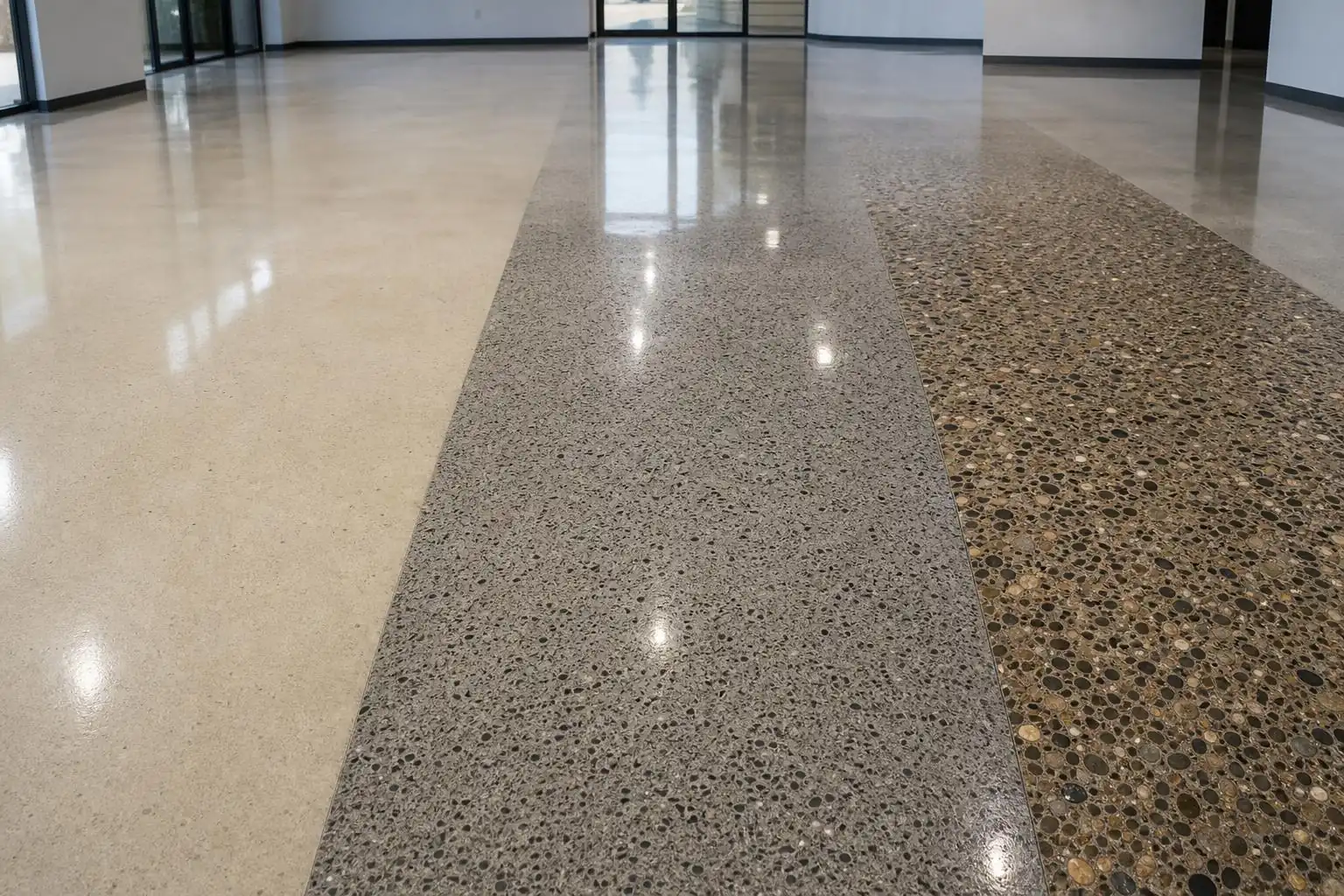
Polished concrete is described by two choices: how much aggregate is exposed (cream, salt and pepper, or full exposure) and how shiny the floor is (from flat or satin to high gloss). Gloss depends on how fine the final diamond grit is. Together these choices set the look, the cost and how forgiving the floor is day to day.
Two Separate Choices: Exposure and Gloss
People often say “level 3 polish” as if it were one decision, but polished concrete really involves two separate specifications. The first is aggregate exposure, meaning how deep the grinders cut and how much stone shows. The second is gloss or reflectivity, which depends on how fine the final polishing steps are. A cream-finish floor can be high gloss, and a full-aggregate floor can be satin.
Understanding both helps you compare quotes and avoid surprises on install day. Our concrete polishing page shows real examples.
Aggregate Exposure Classes
| Class | What you see | Typical grind depth | Notes |
|---|---|---|---|
| Cream | Smooth cement paste, little or no stone | Very shallow | Shows trowel marks and variation; needs a well-finished slab |
| Salt and pepper | Fine sand and small stone specks | Shallow, about 1/16 inch | Most popular; uniform and forgiving |
| Medium exposure | Mix of fine and some larger stone | Moderate | Transitional look |
| Full exposure | Large stone like terrazzo | About 1/8 inch or more | Most dramatic; most labor |
Why existing slabs vary
Slabs are rarely perfectly flat, so grinding to a uniform exposure can reveal more stone in low areas and less in high areas. A sample area shows how your slab behaves.
Gloss Levels and Grit Sequences
After grinding, crews switch to resin-bonded diamonds that refine the scratch pattern. Each step uses a finer grit, typically doubling: 50, 100, 200, 400, 800, 1500 and 3000. Stopping at a coarser grit gives a satin look, while finishing at a fine grit gives a high-gloss, mirror-like finish.
- Flat or ground: stops around 100 to 200 grit, plus a guard. Low sheen.
- Satin: around 400 grit. Soft sheen, hides scuffs.
- Semi-gloss: around 800 grit. Reflective, popular for retail and offices.
- High gloss: 1500 to 3000 grit. Clear reflections, most dramatic.
Industry groups describe these levels with their own terminology, and contractors may measure gloss and clarity with meters on large commercial jobs.
Densifiers, Guards and Dyes
Densifiers
Lithium, sodium or potassium silicate densifiers react with the cement to harden the surface, which helps it take a polish and resist dusting.
Guards
Stain guards are thin penetrating or topical treatments that improve stain resistance and add some sheen. They are maintained over time, not permanent.
Dyes
Water- or solvent-based dyes add color. They are applied partway through the polishing sequence and locked in with densifier. UV-stable dyes are recommended near windows.
Which Combination Should You Choose?
| Space | Common exposure | Common gloss |
|---|---|---|
| Warehouse or industrial | Cream or salt and pepper | Flat to satin |
| Office and retail | Salt and pepper | Semi-gloss |
| Showroom or lobby | Salt and pepper or full | High gloss |
| Residential basement or main floor | Cream or salt and pepper | Satin to semi-gloss |
Higher gloss shows dust and scratches more, so busy entrances often look better at satin or semi-gloss.
Is a Higher Gloss More Slippery?
Gloss is about light reflection, not friction. A dry, clean polished floor is generally not slippery. Water, oil or dust on any smooth floor reduces traction. The >OSHA walking-working surfaces rule (29 CFR 1910.22) requires employers to keep floors clean and, so far as possible, dry, which is the main control for slip safety on polished floors.
Cost Impact of Exposure and Gloss
Each extra grinding and polishing step adds labor and tooling. As typical Front Range estimates for 2026, a cream or salt-and-pepper floor at satin to semi-gloss commonly falls around $3 to $6 per square foot, while full aggregate exposure at high gloss can reach $6 to $12. The >American Concrete Institute offers technical resources on concrete finishing that explain why slab quality influences these numbers so much.
New construction tip
If you want full aggregate exposure in new construction, plan the mix and placement with the concrete contractor. Some projects seed decorative aggregate into the surface during the pour to guarantee the look.
How to specify your choice clearly
When you request quotes, write the specification in plain terms so every contractor prices the same floor:
- Aggregate exposure class, for example salt and pepper
- Final gloss target and final resin grit, for example semi-gloss at 800 grit
- Densifier type and guard product
- Dye color, if any, and whether it must be UV-stable
- Crack and joint treatment and filler color
Matching specs make price comparisons fair and ensure the floor you get is the floor you pictured. It also gives your facility team a written record for future maintenance and repairs.
Why Centennial Property Owners Choose True Finishing
True Finishing has prepared, repaired and finished concrete floors across the Colorado Front Range and mountain towns since 2007. Our crews work in Centennial and nearby communities, and we handle every step ourselves: moisture testing, grinding, crack and joint repair, and the final finish. That one-stop approach means nobody hands off a slab they did not prepare.
In Centennial offices, retail spaces and homes, we start polishing projects with a sample area so owners can see the exposure and gloss on their actual slab before we commit to the full floor. You can see how we approach larger jobs in our commercial case studies.
Ready to talk about your floor? Request a free estimate or call 303-761-1012. We will look at the slab, test it, and give you a written scope with clear pricing.
Frequently Asked Questions
What are the levels of polished concrete?
Polished concrete is defined by aggregate exposure and gloss. Exposure ranges from cream, with little stone showing, to salt and pepper and full aggregate exposure. Gloss ranges from flat or satin to semi-gloss and high gloss, depending on how fine the final diamond grit is. Both choices are specified separately.
What is salt and pepper polished concrete?
Salt and pepper is a finish where the surface is lightly ground to expose fine sand and small stone specks, creating a speckled look. It is the most popular commercial finish because it is uniform, hides minor flaws and requires less grinding than full aggregate exposure.
What grit makes concrete shiny?
Concrete starts to look reflective around 400 to 800 grit resin pads, and high gloss typically requires 1500 to 3000 grit. The final appearance also depends on the slab density, densifier, guard and how well each step removed the scratches from the previous step.
Which polished concrete finish is easiest to maintain?
Salt and pepper exposure at satin or semi-gloss is usually easiest to maintain. It hides dust, small scratches and minor variations better than cream or very high gloss finishes. Regular dust mopping, neutral cleaning and periodic burnishing keep it looking consistent.
Does True Finishing offer polished concrete samples?
Yes. On most projects True Finishing creates a sample area on your slab in Centennial or anywhere on the Front Range so you can see the exposure and gloss before we polish the full floor. Call 303-761-1012 or request a free estimate.