
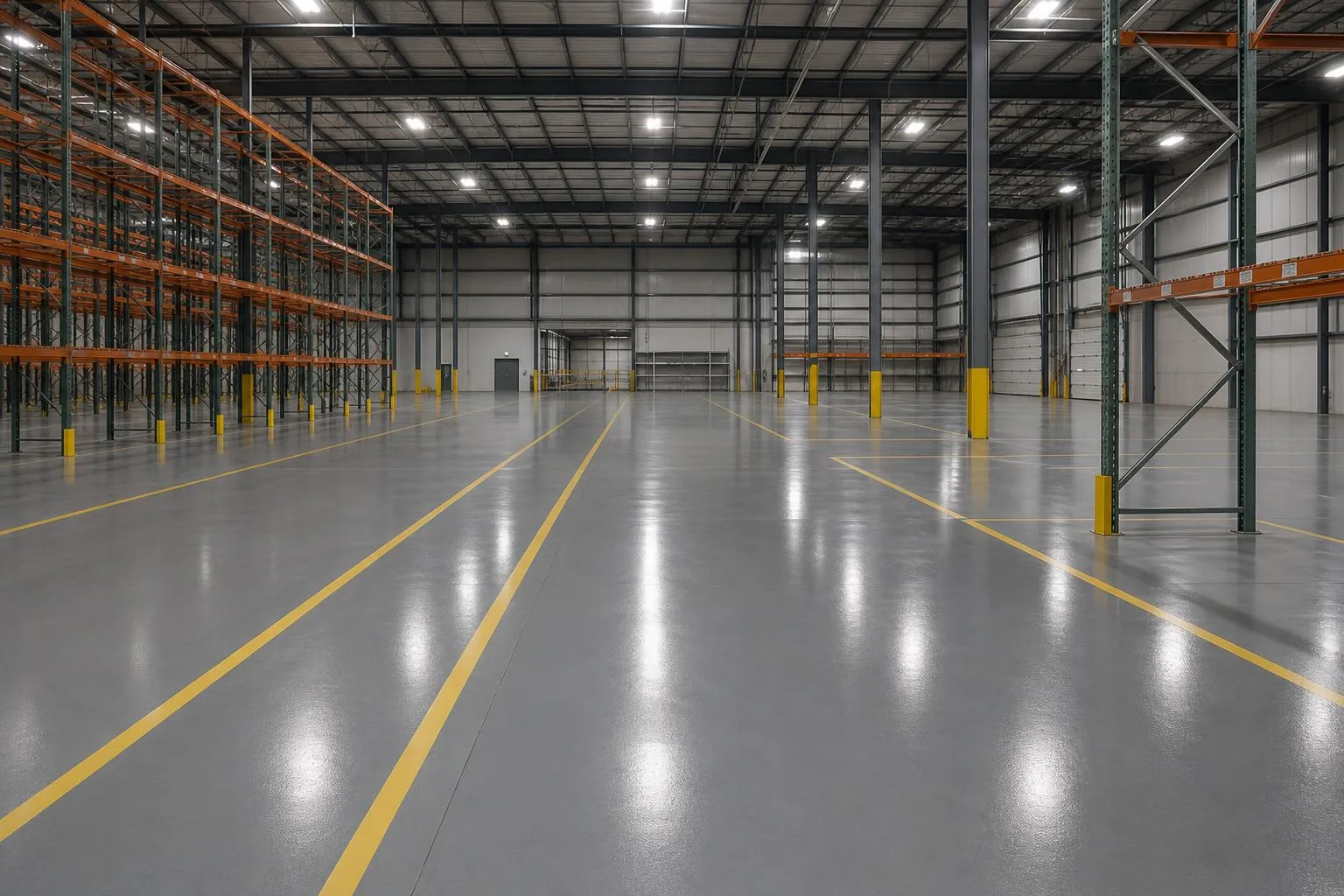
Commercial epoxy flooring is a resin system bonded to concrete that creates a seamless, durable and cleanable surface for warehouses, kitchens, labs, retail and healthcare spaces. The right system depends on traffic, chemicals, temperature, moisture and slip-resistance needs, ranging from thin roll coats to thick troweled mortars with urethane or polyaspartic topcoats.
What Makes Commercial Epoxy Different From Residential
Commercial floors face forklifts, pallet jacks, carts, chemicals, hot water washdowns and constant foot traffic. A garage floor kit or light residential system will not survive those conditions. Commercial epoxy systems are engineered around measurable demands: abrasion, impact, chemical exposure, thermal shock and slip resistance.
Specifications typically state thickness in mils, the number of coats, the type of primer and topcoat, and any aggregate for texture. Industry organizations such as >AMPP develop standards for protective coatings that many specifiers reference alongside manufacturer data.
Common Commercial Epoxy Systems
| System | Typical thickness | Common uses |
|---|---|---|
| Roll-coat epoxy | About 10 to 20 mils | Light storage, back-of-house, mechanical rooms |
| High-build epoxy | About 20 to 40 mils | Warehouses, showrooms, retail |
| Broadcast quartz or flake | About 1/16 to 1/8 inch | Restrooms, locker rooms, labs |
| Self-leveling slurry | About 1/8 inch | Manufacturing, clean production |
| Epoxy or urethane mortar | About 1/4 inch or more | Food processing, heavy impact, thermal shock |
See our epoxy flooring page for system details.
Choosing the Right Topcoat
The topcoat determines much of how the floor performs day to day.
- Epoxy topcoats offer chemical resistance but may amber under UV.
- Aliphatic urethane topcoats improve abrasion resistance and UV stability.
- Polyaspartic topcoats cure fast, which shortens downtime, and resist UV well.
- Urethane cement is used where hot water washdowns and thermal shock are common, such as commercial kitchens and food plants.
Slip Resistance and Safety
Employers must keep walking-working surfaces safe under >OSHA 29 CFR 1910.22, which requires floors to be kept clean, orderly and, where wet processes are used, maintained with drainage or dry standing places. Floors in wet or greasy areas often get aggregate broadcast into the topcoat for traction.
Line striping and safety markings
Aisle lines, pedestrian walkways, forklift zones and hazard markings can be installed as part of the coating system so they wear with the floor rather than peeling like tape.
Planning Downtime in an Operating Facility
For most businesses, downtime is the biggest cost of a new floor. Good planning keeps operations moving:
- Phase the floor into zones and move equipment between them.
- Use fast-cure primers and polyaspartic topcoats where turnaround is critical.
- Schedule grinding and coating overnight or over weekends.
- Plan for dust control, ventilation and odor management in occupied buildings.
- Set clear return-to-service times for foot traffic, carts and forklifts.
Typical Commercial Epoxy Costs
As a typical Front Range estimate for 2026, commercial epoxy flooring ranges from about $4 per square foot for simple roll-coat systems on large open floors to $12 or more for thick mortar and urethane cement systems. Prep, moisture mitigation, coves, striping and after-hours work all affect the final number. Large projects benefit from economies of scale, while small rooms with many edges cost more per square foot.
Lifecycle value
Commercial epoxy floors are commonly recoated rather than replaced. A well-maintained system can be lightly abraded and topcoated to restore protection, which spreads the cost over many years of service.
Case Study Thinking: Matching System to Use
Every facility is different. A distribution center needs abrasion resistance in forklift lanes, a medical office needs easy sanitation and low odor during installation, and a retail store needs appearance and fast turnover. Reviewing how similar spaces performed, like our commercial case studies, helps owners choose a system confidently.
Before you finalize a spec, walk the space with the installer, note chemicals in use, measure temperatures and identify wet areas. That information turns a generic coating into a floor that fits the building.
Maintenance plans that protect the investment
A commercial epoxy floor lasts longest when cleaning and inspection are part of normal operations. Most facilities do well with a simple plan:
- Daily sweeping or auto-scrubbing with a neutral cleaner to remove grit that abrades the topcoat.
- Prompt cleanup of chemical spills, even on chemical-resistant systems.
- Walk-off mats at entries to limit tracked-in sand and de-icer during Colorado winters.
- Annual inspection of forklift lanes, dock plates and drains, where wear shows first.
- Scheduled topcoat refresh when gloss and protection fade in traffic lanes.
Facilities that follow a plan like this often go many years between major projects, and when work is needed, it is usually a targeted recoat rather than a full replacement. Keeping a log of inspections, spills and repairs also helps when it is time to plan budgets for the next fiscal year. Ask your installer for written care instructions that match the exact products on your floor.
Why Centennial Property Owners Choose True Finishing
True Finishing has prepared, repaired and finished concrete floors across the Colorado Front Range and mountain towns since 2007. Our crews work in Centennial and nearby communities, and we handle every step ourselves: moisture testing, grinding, crack and joint repair, and the final finish. That one-stop approach means nobody hands off a slab they did not prepare.
We work with facility managers and general contractors in Centennial and across the Denver Tech Center area, coordinating installations around shifts, shutdowns and occupied buildings. You can see how we approach larger jobs in our Sierra Trading Post project.
Ready to talk about your floor? Request a free estimate or call 303-761-1012. We will look at the slab, test it, and give you a written scope with clear pricing.
Frequently Asked Questions
How much does commercial epoxy flooring cost?
As a typical Front Range estimate for 2026, commercial epoxy flooring costs about $4 to $12 or more per square foot. Simple roll-coat systems on large open floors sit at the low end, while thick mortar, urethane cement and moisture-mitigated systems cost more. Downtime planning and after-hours work also affect price.
How long does commercial epoxy flooring last?
Commercial systems commonly last 10 to 20 years depending on traffic, thickness and maintenance. High-traffic forklift lanes wear faster than storage areas. Many floors are maintained by abrading and recoating the topcoat every several years, which restores protection without replacing the full system.
How long does a business need to close for epoxy installation?
It depends on floor size, system and cure times. Small areas may be completed over a weekend using fast-cure products. Larger facilities are often phased by zone so operations continue. Foot traffic usually returns within a day, while forklifts may need several days on standard epoxy systems.
Is epoxy flooring slip resistant?
Smooth epoxy can be slippery when wet or oily. Commercial systems add texture by broadcasting aggregate such as quartz or aluminum oxide into the topcoat. The level of texture is chosen for the area, balancing slip resistance with cleanability. Wet and greasy areas typically need more texture than dry warehouses.
Does True Finishing install commercial epoxy?
Yes. True Finishing installs commercial epoxy, urethane and polished concrete floors in Centennial, Denver and across the Front Range, with prep, moisture mitigation and striping done in-house. Call 303-761-1012 or request a free estimate to discuss your facility.